

Best pillow for combination sleepers choices can feel confusing because your head and neck need different support when you move from your side to your back or stomach during the night. A pillow that feels perfect at bedtime may feel too high when you roll onto your back. Likewise, a pillow that feels great on your back may feel too flat when you turn onto your side.
The good news is that you do not need three different pillows. Instead, you need a pillow that can adapt to your changing sleep positions.
Combination sleepers often move between two or more positions without even noticing. Some people start on their side, spend part of the night on their back, and finish on their stomach. Others switch from back to side many times. Therefore, flexibility matters more than choosing a pillow made for only one position.
The right pillow should keep your head comfortable while helping your neck stay in a natural position. It should also have enough support for side sleeping but enough flexibility for back and stomach sleeping.
According to Sleep Foundation, side sleepers often need more loft than back sleepers, while stomach sleepers generally need a much lower loft.
That difference explains why combination sleepers need a careful balance.
This guide explains how to choose that balance. You will learn about loft, firmness, fill, shape, cooling, mattress type, body size, washing, price, common mistakes, and much more. You will also find a comparison chart, real-life examples, expert advice, advantages, disadvantages, and 20 FAQs.
Why Combination Sleepers Need a Special Pillow
Combination sleepers do not stay in one position all night. As a result, a pillow designed for one position may not work well for the entire night.
For example, a high pillow can feel wonderful when you sleep on your side because it fills the space between your shoulder and head. However, that same height may push your head too far forward when you roll onto your back.
On the other hand, a very thin pillow may feel comfortable on your stomach. Yet, it may leave your head unsupported when you turn onto your side.
Therefore, combination sleepers need a middle ground.
The goal is not to find a pillow that feels exactly the same in every position. Instead, look for a pillow that remains comfortable and supportive as your position changes.
What Makes the Best Pillow for Combination Sleepers Different?
The best pillow for combination sleepers usually has three important qualities: adaptable height, balanced firmness, and good shape retention.
An adjustable pillow is especially useful because you can remove or add filling. This lets you create a lower profile for back or stomach sleeping and a higher profile for side sleeping.
Sleep Foundation notes that adjustable pillows can help sleepers fine-tune loft and firmness.
A pillow with shredded memory foam or shredded latex can also work well because you can move the filling around.
However, flexibility does not mean the pillow should feel loose or flat. It still needs enough structure to support your head.
Understand Loft Before Buying
Loft means the height or thickness of a pillow.
In simple terms, it tells you how high your head will sit above the mattress.
Sleep Foundation generally describes low loft as under 3 inches, medium loft as 3 to 5 inches, and high loft as more than 5 inches.
These numbers are useful, but they are not strict rules.
Your body weight, shoulder width, mattress firmness, and preferred position also change the amount of loft you need.
For example, a broad-shouldered side sleeper may need more height than a smaller person.
Meanwhile, a sleeper on a soft mattress may need less pillow height because the shoulder sinks farther into the mattress.
The Ideal Loft for Side-to-Back Sleepers
If you mainly move between your side and back, start with medium loft.
A pillow around the middle of the 3-to-5-inch range can provide a useful balance.
However, an adjustable pillow may be even better.
You can keep more filling when you want side support. Then, you can remove some filling when you spend more time on your back.
Sleep Foundation also recommends considering mattress firmness because a softer mattress can reduce the space between your head and the mattress.
Side Sleeping Changes Everything
Side sleeping creates a larger gap between your head and the mattress.
Your shoulder takes up some of that space. Therefore, your pillow must fill the remaining gap.
If your pillow is too thin, your head can fall toward the mattress.
If it is too thick, your head may tilt upward.
Neither situation is ideal for comfort.
A medium-to-high loft pillow often works better for side sleepers. Sleep Foundation says side sleepers generally benefit from thicker pillows that fill the space between the head and shoulder.
Back Sleeping Needs a Different Balance
Back sleeping usually requires less loft than side sleeping.
When you lie on your back, your head sits closer to the mattress. Therefore, a very tall pillow can push your head forward.
A medium loft is often a good starting point.
You also want enough support under the neck without creating a large bend.
Sleep Foundation reports that back sleepers generally do well with medium-loft pillows and moderate firmness.
Stomach Sleeping Requires Extra Care
Stomach sleeping creates a different challenge.
Your head must turn to one side so you can breathe. A tall pillow can make that angle even larger.
For this reason, stomach sleepers usually prefer low, soft pillows.
Sleep Foundation recommends low-loft pillows for stomach sleepers, often under 3 inches.
Cleveland Clinic also warns that stomach sleeping can place extra stress on the neck, shoulders, and back.
So, if you regularly sleep on your stomach, avoid a very tall and firm pillow.
Best Pillow for Combination Sleepers Who Sleep Side and Stomach
The best pillow for combination sleepers who move between side and stomach positions should have adjustable or compressible filling.
This is important because side sleeping needs more height while stomach sleeping needs less.
A shredded foam pillow can work because you can shape it with your hands.
Another option is a soft fiber pillow that compresses when you place your head on it.
However, very soft pillows can lose their shape during the night.
Therefore, look for a model that compresses without completely collapsing.
Best Pillow for Combination Sleepers Who Sleep Back and Stomach
For people who move between back and stomach sleeping, lower loft is usually a safer starting point.
A soft or medium-soft pillow can provide enough cushioning without lifting the head too high.
An adjustable pillow gives you even more control.
Keep less filling inside the pillow when you expect more stomach sleeping.
Then, add some filling if you notice that your head drops too low when you sleep on your back.
Best Pillow for Combination Sleepers Who Change Positions Often
Some sleepers change positions every few minutes.
If that sounds like you, look for a pillow that responds quickly.
Shredded memory foam, latex, down alternative, and adjustable hybrid fills can all provide different levels of adaptability.
However, your personal feel matters.
A pillow can have excellent materials but still feel wrong to you.
Sleep Foundation emphasizes that personal comfort plays a major role when choosing pillows.
Adjustable Fill Can Be a Game Changer
Adjustable filling is one of the most useful features for combination sleepers.
Many adjustable pillows have a zipper that lets you open the inner chamber.
You can then remove some filling if the pillow feels too high.
Alternatively, you can add filling if the pillow feels too flat.
This feature also helps when your preferences change.
For example, you might want more support while sleeping on your side during one part of the night.
Later, you can shift your head onto a thinner section.
Why Shredded Memory Foam Works Well
Shredded memory foam can provide a mix of support and flexibility.
Unlike one solid foam block, shredded foam pieces can move around.
You can squeeze or shape the pillow to create a higher or lower area.
The material also tends to provide pressure relief.
However, memory foam can hold heat. Therefore, hot sleepers should look for breathable covers and designs that improve airflow.
Sleep Foundation notes that pillow fill and cover materials affect temperature control.
Is Latex a Good Choice?
Latex can be a strong choice for people who want a responsive pillow.
It usually springs back faster than memory foam.
That means it does not feel as slow or deeply sinking.
Latex can also provide steady support as you change positions.
However, latex pillows may feel firmer than some fiber or down-style pillows.
Therefore, they may not suit someone who prefers a very soft and fluffy feel.
Down and Down Alternative Options
Down pillows feel soft, light, and easy to shape.
You can often fold or squeeze them into a comfortable position.
However, very soft down can flatten under your head.
Down alternative pillows can offer a similar fluffy feel while using synthetic fibers.
These options may work well for combination sleepers who prefer a soft pillow.
Still, you should check how well the pillow holds its shape.
Memory Foam Versus Fiber Fill
Memory foam usually provides stronger structure.
Fiber fill generally provides a softer and more flexible feel.
If you move often, fiber may feel easy to adjust.
If you need stronger neck support, foam may feel more stable.
A hybrid pillow can offer a middle ground.
For example, shredded foam inside a soft fiber layer can provide support without feeling extremely firm.
Firmness Matters as Much as Height
Many shoppers focus only on pillow height.
That is a mistake.
Firmness matters too.
A tall, soft pillow can compress dramatically.
A shorter, firm pillow may maintain its height.
Therefore, two pillows with the same advertised loft can feel completely different.
Combination sleepers often benefit from medium firmness because it provides support while still allowing some movement.
Your Mattress Changes Your Pillow Choice
Your mattress and pillow work together.
A soft mattress allows your body to sink more deeply.
Therefore, your head may sit closer to the mattress.
A firm mattress keeps your body higher.
That can create a larger gap between your head and the mattress.
Sleep Foundation specifically notes the relationship between mattress firmness and pillow loft.
So, do not choose a pillow without thinking about your mattress.
Broad Shoulders Need More Support
Shoulder width affects side sleeping.
A person with broad shoulders may create a larger gap between the head and mattress.
As a result, a thin pillow may not provide enough support.
A taller or adjustable pillow may work better.
However, do not automatically choose the tallest pillow available.
Test the position of your head and neck instead.
Smaller Frames May Need Less Loft
People with smaller frames often place less pressure on pillows.
Therefore, a very thick pillow can feel too tall.
A lower or medium loft may work better.
Still, there is no universal rule.
Your shoulder width and mattress matter too.
That is why adjustable filling is useful.
The Best Pillow for Combination Sleepers Should Stay Stable
The best pillow for combination sleepers should not turn into a flat pancake after a few hours.
Shape retention matters because you move around.
A pillow that loses its height can leave you searching for support at 3 a.m.
Look for a pillow that keeps its shape but still allows you to move your head naturally.
Adjustable shredded foam and responsive latex can perform well in this area.
Cooling Is Important for Active Sleepers
People who move around often may also feel warm.
A pillow that traps heat can make sleep less comfortable.
Memory foam is known for heat retention in some designs.
However, manufacturers can improve cooling with breathable covers, ventilation, gel features, and open structures.
Sleep Foundation recommends considering materials and airflow when temperature control matters.
Therefore, hot sleepers should not choose a pillow based only on firmness.
Choose a Breathable Cover
A breathable cover can make a noticeable difference.
Cotton, some bamboo-based fabrics, linen blends, and other breathable materials can feel comfortable.
However, the cover is only one part of cooling.
The inner fill also affects heat.
Therefore, check the complete construction rather than trusting a word such as “cooling” on the package.
Shape Can Improve Position Changes
Traditional rectangular pillows work for many people.
However, contoured pillows can offer extra support.
A contoured pillow may have a higher edge for side sleeping and a lower center for back sleeping.
This can be useful for combination sleepers.
Sleep Foundation notes that combination sleepers may benefit from pillows that combine features for different sleeping positions.
Still, some people dislike fixed shapes.
If you move a lot, an adjustable rectangular pillow may feel more natural.
Cervical Designs: Helpful or Too Much?
Cervical pillows have shaped areas designed to support the neck.
They can feel excellent for some sleepers.
However, they are not automatically better.
If you move between positions frequently, a fixed contour may not match every position.
Therefore, consider a cervical pillow if you like structured support and tend to stay in a small range of positions.
Otherwise, an adjustable pillow may provide more freedom.
Pillow Size Makes a Difference
Standard pillows are compact.
Queen pillows offer more room.
King pillows provide even more surface area.
Combination sleepers who move widely across the bed may enjoy a larger pillow.
However, bigger does not always mean better.
A large pillow may take up too much bed space.
Choose a size that gives you room without changing how you naturally sleep.
How to Test Your Pillow at Home
Testing your pillow at home is one of the best ways to judge it.
First, lie on your side.
Look at your head and neck position.
Then, roll onto your back.
Notice whether your chin moves toward your chest.
Next, try your stomach position if you regularly sleep that way.
Finally, stay in each position for several minutes.
A short test can reveal obvious problems.
If the pillow feels uncomfortable immediately, it probably needs adjustment.
The Wall Test for Pillow Height
Try a simple wall test.
Stand with your back against a wall.
Keep your head in a natural position.
Then notice how your neck feels.
This does not give you an exact pillow measurement.
However, it helps you understand what neutral head position feels like.
When you lie down, try to recreate that natural feeling.
Your goal is comfort rather than a perfect number.
A Simple Morning Check
Your body can also give you useful clues.
When you wake up, ask yourself:
- Does my neck feel stiff?
- Did I wake with shoulder pressure?
- Did I keep moving my pillow?
- Did I feel comfortable on my back?
- Did the pillow flatten?
- Did I wake feeling too hot?
- Did my head feel pushed forward?
Keep notes for several nights.
One bad night does not always mean the pillow failed.
However, repeated discomfort deserves attention.
Signs Your Pillow Is Too High
A pillow may be too high if your head feels pushed forward.
You may also notice pressure around your neck.
Side sleepers can also experience a head tilt if the pillow is much taller than needed.
If this happens, remove some filling if the pillow allows it.
Otherwise, try a lower pillow.
Signs Your Pillow Is Too Low
A pillow may be too low if your head sinks toward the mattress.
Side sleepers often notice this quickly.
You may feel as though your neck has to bend sideways.
If your pillow allows adjustment, add some filling.
If not, consider a higher-loft option.
Real-Life Example: The Side-to-Back Sleeper
Imagine Sarah.
She starts every night on her right side.
After a few hours, she naturally rolls onto her back.
Her old pillow feels perfect on her side.
However, when she rolls onto her back, she feels as though her head is pushed forward.
Sarah switches to a medium-loft adjustable pillow.
She removes some filling until her head feels comfortable on her back.
Then, she shapes the remaining filling under her neck when she sleeps on her side.
This example shows why adjustability can matter more than a simple “soft” or “firm” label.
Real-Life Example: The Stomach-to-Side Sleeper
Now consider Mark.
He falls asleep on his stomach but wakes several times on his side.
His thick foam pillow feels comfortable when he sleeps on his side.
However, it feels too high when he rolls onto his stomach.
Instead of buying two pillows, Mark chooses a compressible adjustable pillow.
He uses less filling and creates a softer profile.
That gives him enough side support without creating a very tall surface for stomach sleeping.
Case Study: A Broad-Shouldered Combination Sleeper
Consider another example.
James has broad shoulders and sleeps mostly on his side. However, he often changes to his back.
His thin pillow keeps collapsing.
As a result, his head drops too far toward the mattress.
He tries a medium-height pillow but still needs more side support.
Finally, he chooses an adjustable pillow with extra fill.
He keeps enough filling to support his shoulders while removing enough to make back sleeping comfortable.
The lesson is simple: body shape changes pillow needs.
Case Study: A Hot Sleeper
Maria changes positions often and sleeps warm.
Her memory foam pillow feels supportive, but she wakes with a hot head.
She changes to a pillow with shredded fill and a breathable cover.
The new design allows more airflow.
She also uses a lighter pillowcase.
The result is a cooler sleeping surface.
The lesson is that comfort depends on more than support.
Advantages of an Adjustable Pillow
An adjustable pillow offers several benefits.
Advantages include:
- You can change the loft.
- You can change the firmness.
- You can adapt it to different positions.
- You can adjust it after changing mattresses.
- You can remove filling as the pillow ages.
- You can create more neck support.
- One pillow may replace several different pillows.
For combination sleepers, these benefits can make adjustable designs especially practical.
Disadvantages of an Adjustable Pillow
Adjustable pillows are not perfect.
Possible disadvantages include:
- They can require trial and error.
- Loose filling may shift.
- Some designs need regular fluffing.
- Shredded foam may feel uneven.
- Opening the pillow can be messy.
- Some models cost more than basic pillows.
- Some people prefer the simple feel of one solid pillow.
Therefore, choose adjustability only if you actually want to customize your pillow.
Advantages of Memory Foam
Memory foam can provide strong support.
It can also spread pressure across the head and neck.
Shredded memory foam gives you more flexibility than solid foam.
Additionally, it can hold its shape well.
However, heat remains a possible concern.
If you sleep hot, look for breathable construction.
Disadvantages of Memory Foam
Memory foam may feel too firm for people who prefer a fluffy pillow.
Some foam also has an odor when new.
Furthermore, solid foam may not suit sleepers who change positions constantly.
Therefore, shredded foam may be a better choice for some combination sleepers.
Advantages of Latex
Latex usually feels responsive.
It quickly returns to its shape when you move.
That can help people who change positions often.
Latex can also provide steady support without the deep sinking feel of some memory foam.
However, latex can feel firmer and may cost more.
Disadvantages of Latex
Latex is not for everyone.
Some people prefer a softer, more compressible pillow.
Others may dislike the springy feel.
Additionally, latex pillows can be heavier than simple fiber pillows.
Therefore, think about feel as well as support.
Expert Advice: Focus on Alignment, Not Marketing Words
Sleep experts consistently point to sleep position, loft, firmness, body type, and personal comfort when choosing pillows.
That means words such as “orthopedic,” “luxury,” or “cooling” should not make the decision for you.
Instead, ask simple questions.
Does the pillow support your head?
Does it feel comfortable when you move?
Does it keep a natural position?
Does it stay supportive during the night?
Those questions are more useful than a fancy label.
Expert Advice: Give Your Pillow Time
A new pillow can feel strange.
Your body may be used to an old pillow.
Therefore, do not judge a pillow after only five minutes unless it creates obvious discomfort.
Give it enough time to understand how it feels during real sleep.
However, do not force yourself to use a pillow that causes repeated pain or strong discomfort.
How to Keep Your Pillow Clean
A clean pillow can improve the overall sleep experience.
Always follow the manufacturer’s care instructions.
Use a washable pillow protector when possible.
Wash the cover regularly.
If the inner pillow cannot go into a washing machine, keep it protected with a removable cover.
Also, allow the pillow to dry fully after washing.
Moisture can create unwanted smells and damage some materials.
When Should You Replace a Pillow?
Pillows do not last forever.
They can lose shape and support as materials break down.
Sleep Foundation notes that pillows typically need replacement after a few years, although lifespan varies by material and use.
Replace your pillow when it stays flat, becomes lumpy, develops permanent dents, or no longer feels supportive.
You should also consider replacement if you regularly wake with discomfort and the pillow appears worn.
Best Pillow for Combination Sleepers: Final Buying Checklist
Before buying the best pillow for combination sleepers, use this checklist:
- Choose adjustable loft when possible.
- Consider medium loft as a starting point.
- Look for medium or medium-firm support.
- Consider your main sleep positions.
- Think about shoulder width.
- Check your mattress firmness.
- Look for breathable materials if you sleep hot.
- Choose a washable cover.
- Check the return or trial policy.
- Avoid choosing only by price.
- Test the pillow in every position you use.
- Replace a pillow that has permanently flattened.
- Choose comfort over marketing claims.
Comparison Chart: Pillow Types for Combination Sleepers
| Pillow Type | Side Sleeping | Back Sleeping | Stomach Sleeping | Adjustability | Cooling | Best For |
| Adjustable shredded foam | Excellent | Excellent | Good | Excellent | Good | Frequent position changes |
| Solid memory foam | Excellent | Good | Fair | Low | Fair | Strong support |
| Latex | Excellent | Excellent | Good | Medium | Good | Responsive feel |
| Down | Good | Excellent | Good | High | Good | Soft comfort |
| Down alternative | Good | Excellent | Good | High | Good | Budget-friendly softness |
| Contoured foam | Excellent | Excellent | Fair | Low | Fair | Structured support |
| Buckwheat | Excellent | Good | Fair | Excellent | Excellent | Firm adjustable support |
| Very soft fiber | Fair | Excellent | Excellent | Medium | Good | Stomach/back sleepers |
These ratings are general guidance, not guarantees. Your body shape, mattress, and comfort preference can change the result.
How to Choose the Best Pillow for Combination Sleepers by Budget
You do not need to spend a huge amount of money.
Budget pillows can work well if they provide the right height and support.
Mid-range pillows often provide better covers, adjustable fill, stronger construction, or better materials.
Premium pillows may offer special cooling fabrics, advanced shapes, natural materials, or long trial periods.
However, expensive does not automatically mean better.
A $50 pillow that matches your sleep style can be much better for you than a $200 pillow that does not.
Therefore, focus on features before price.
Best Pillow for Combination Sleepers by Sleep Position
If you mainly sleep side and back, choose medium or adjustable loft.
If you mainly sleep side and stomach, choose adjustable fill with a soft-to-medium feel.
If you mainly sleep back and stomach, choose a lower-loft pillow.
If you move through all three positions, adjustable fill is one of the most flexible choices.
The goal is always the same: enough support without forcing your head into an uncomfortable angle.
Best Pillow for Combination Sleepers With Neck Discomfort
If you wake with repeated neck discomfort, your pillow may not be the only reason.
Your mattress, sleeping position, posture, daily activities, and other factors can also matter.
Still, pillow height is worth checking.
Try lowering the pillow if your head feels pushed forward.
Try increasing the loft if your head drops too far when side sleeping.
If discomfort continues or becomes severe, talk with a qualified health professional rather than relying on a pillow alone.
Best Pillow for Combination Sleepers Who Sleep Hot
Hot sleepers should focus on airflow.
Look for breathable covers and fills that do not trap too much heat.
Shredded constructions can sometimes allow more air movement than dense solid foam.
Latex can also be a useful option for people who prefer a responsive feel.
However, cooling depends on your whole sleep setup.
Your room temperature, mattress, sheets, blanket, and clothing all matter.
Best Pillow for Combination Sleepers Who Toss and Turn
If you toss and turn, avoid a pillow that locks your head into one position unless you know that design works for you.
Instead, consider a pillow that changes shape naturally.
Adjustable shredded foam can work well because you can move the filling.
A flexible fiber pillow may also suit people who like a soft surface.
The most important feature is freedom of movement combined with enough support.
Best Pillow for Combination Sleepers With Broad Shoulders
Broad shoulders can increase the distance between the mattress and your head during side sleeping.
Therefore, you may need more loft.
However, your mattress can reduce that need.
If your mattress is very soft, your shoulder may sink into it.
If your mattress is firm, you may need a thicker pillow.
An adjustable pillow gives you the easiest way to fine-tune this balance.
Best Pillow for Combination Sleepers on a Soft Mattress
A soft mattress allows your shoulder and body to sink.
That can reduce the amount of pillow height you need.
Therefore, do not automatically buy a high-loft pillow simply because you sleep on your side.
Test a medium loft first.
Then increase the height if your head falls too low.
Sleep Foundation’s pillow research also highlights the connection between mattress firmness and pillow loft.
Best Pillow for Combination Sleepers on a Firm Mattress
A firm mattress creates less body sink.
Therefore, the gap between your head and mattress can be larger.
Side sleepers may need additional loft.
Back sleepers may still prefer medium loft.
Stomach sleepers should remain careful with height.
Your sleep position should always remain part of the decision.
Why One Pillow Can Be Better Than Three
Some combination sleepers keep several pillows on the bed.
That can work.
However, switching pillows during the night can be annoying.
An adjustable pillow may solve that problem.
You can shape one pillow to support your changing positions.
You can also keep a small backup pillow nearby for special needs.
For example, a thin pillow can help if you spend more time on your stomach.
Pillow Layering for Combination Sleepers
Some people like to use two pillows.
For example, you could use a supportive pillow underneath and a thin, soft pillow on top.
However, layering changes total height.
Therefore, check your neck position after adding the second pillow.
If the combined height feels too high, remove one.
More pillows do not automatically mean more comfort.
Using a Towel to Test Pillow Height
Before buying a new pillow, try a simple experiment.
Fold a towel.
Place it inside your pillowcase.
Then adjust the thickness.
This can help you understand whether you need more or less loft.
It is not a perfect replacement for a real pillow.
However, it can help you test height before spending money.
What Combination Sleepers Should Avoid
Combination sleepers should avoid pillows that are too high, too flat, or too unstable.
Avoid extremely high pillows if you regularly sleep on your back or stomach.
Avoid very thin pillows if you spend a lot of time on your side.
Avoid pillows that flatten completely during the night.
Also, avoid buying a pillow only because it has a high price or attractive advertising.
Instead, choose based on your actual sleep habits.
Common Pillow Buying Mistakes
One common mistake is buying a pillow based only on firmness.
Another mistake is choosing height without considering mattress firmness.
Some shoppers also ignore body size.
Others buy a pillow made for one position even though they change positions every night.
Finally, many people do not use the return period.
If a brand offers a trial, use it.
Your bedroom is the best testing environment.
How Long Should You Test a New Pillow?
Try your new pillow for several nights if it feels reasonably comfortable.
Give your body time to adjust.
However, if it immediately creates strong pain or severe discomfort, stop using it.
Keep notes about each morning.
Write down your sleep position, comfort level, temperature, and neck or shoulder feeling.
After several nights, you may see a clear pattern.
A Five-Step Pillow Buying Method
Use this simple method:
Step 1: Identify your two most common sleeping positions.
Step 2: Choose a medium loft if you are unsure.
Step 3: Prefer adjustable filling if you change positions often.
Step 4: Check the pillow against your mattress firmness.
Step 5: Test it for comfort in every position.
This approach is simple and avoids many common buying mistakes.
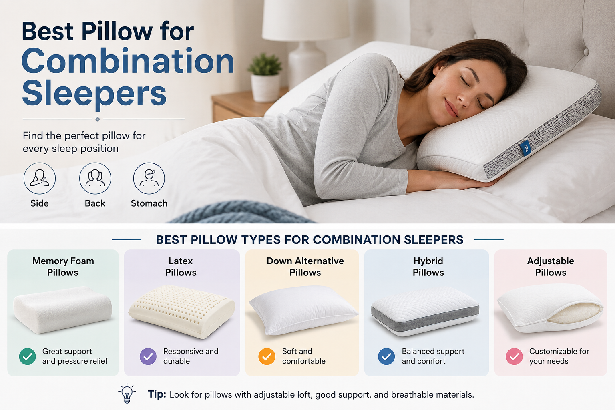
FAQs About the Best Pillow for Combination Sleepers
- What is the best pillow for combination sleepers?
The best pillow for combination sleepers is usually adjustable, medium loft, and medium firmness. This combination can provide enough flexibility for side, back, and stomach sleeping.
- Should combination sleepers use an adjustable pillow?
Yes, an adjustable pillow can be very useful. You can add or remove filling to change the height and feel.
- What pillow loft is best for combination sleepers?
Medium loft is a good starting point. However, side sleepers may need more height, while stomach sleepers usually need less.
- Is memory foam good for combination sleepers?
Yes. Shredded memory foam can be especially useful because you can move and adjust the filling.
- Is latex good for combination sleepers?
Latex can work well because it responds quickly when you move. It can also provide steady support.
- Should combination sleepers use a firm pillow?
A medium or medium-firm pillow often provides a useful balance. However, your comfort and sleep positions should guide the final choice.
- What is the best pillow for side and back sleepers?
An adjustable medium-loft pillow is a strong option. You can increase the fill for side sleeping and reduce it for back sleeping.
- What is the best pillow for side and stomach sleepers?
Choose a pillow that can compress or lose some height. Adjustable fill can help you find the right balance.
- Can a high pillow cause neck discomfort?
Yes, a pillow that is too high can push your head into an uncomfortable position. Back and stomach sleepers need to be especially careful with excessive height.
- Can a low pillow cause problems?
A low pillow may not fill the space between your head and mattress when you sleep on your side. This can make the head fall toward the mattress.
- Are cooling pillows worth buying?
They can be useful if you sleep hot. However, check the entire pillow construction because the cover alone does not determine temperature control.
- What pillow material is coolest?
Breathable materials and designs that allow airflow can feel cooler. Latex and some breathable shredded constructions may work well, while dense foam can feel warmer.
- Should I use one pillow or two?
One adjustable pillow may be enough. However, some people prefer a second thin pillow for extra support.
- Does body weight affect pillow choice?
Yes. Heavier sleepers may compress soft pillows more deeply, while lighter sleepers may need less loft and firmness.
- Does shoulder width matter?
Yes. Wider shoulders can create a larger gap between the head and mattress during side sleeping. Therefore, broader shoulders may need more pillow height.
- Does mattress firmness affect pillow choice?
Yes. A softer mattress allows the body to sink, which can reduce the pillow height needed. A firmer mattress may require more loft.
- How often should I replace my pillow?
Replace it when it loses its shape, becomes permanently flat, develops lumps, or stops providing comfortable support. Many pillows last several years, but lifespan varies.
- Is a contoured pillow good for combination sleepers?
It can be. However, some combination sleepers prefer adjustable pillows because they allow more freedom when changing positions.
- Can a pillow help with sleep comfort?
A properly fitted pillow can improve head and neck support and make sleeping more comfortable. However, it cannot fix every sleep or pain problem.
- How do I know I picked the right pillow?
You should feel comfortable in your normal sleeping positions. Your head should feel supported without being pushed too high or allowed to sink too low. Also, you should not need to constantly reshape the pillow during the night.
Final Verdict: Finding Your Ideal Pillow
Choosing the best pillow for combination sleepers is mainly about balance.
You need enough height for side sleeping.
At the same time, you need enough flexibility for back and stomach sleeping.
You also need a pillow that works with your mattress, body shape, temperature preference, and personal comfort.
For many combination sleepers, an adjustable pillow is the easiest place to start. You can change the filling instead of replacing the entire pillow when your needs change.
If you mainly sleep on your side and back, try medium loft with medium support.
If you often sleep on your stomach, choose a lower and more compressible profile.
If you sleep hot, focus on breathable materials and airflow.
If you have broad shoulders, consider extra loft, but always check how your mattress changes the gap beneath your head.
Most importantly, do not chase a perfect number.
The right pillow is the one that lets you move naturally while keeping your head and neck comfortable.
Sleep Foundation’s current pillow guidance also stresses that personal preference, sleep position, loft, firmness, body type, and mattress firmness all matter when selecting a pillow.
So, start with the features that match your sleeping style. Then adjust from there.
A good pillow should not make you think about your pillow all night. Instead, it should quietly support you while you sleep.
External Resources for Further Reading
- Sleep Foundation — Types of Pillows and Sleep Positions — Useful guidance on pillow loft, firmness, and sleeping positions.
- Sleep Foundation — How to Shop for Pillows — Helpful information about loft, materials, temperature, and firmness.
- Sleep Foundation — Pillow Research Methodology — Explains how pillow characteristics and mattress firmness affect sleep comfort.
- Cleveland Clinic — Sleeping on Your Stomach — General information about stomach sleeping and neck, shoulder, and back strain.