
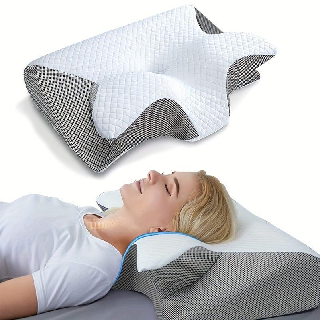
The best pillow for neck support is not the same for everyone. Your sleeping position, shoulder width, mattress firmness, pillow height, and personal comfort all matter. In most cases, a pillow that keeps your head and neck in a neutral line is a better choice than one that simply feels soft.
Best Pillow for Neck Support: Start With Alignment
Best pillow for neck support should keep your head level with the rest of your spine.
That sounds simple, but many people choose a pillow because it feels soft when they first lie down. However, comfort during the first five minutes does not always mean good support for eight hours.
Cleveland Clinic experts recommend choosing a pillow that avoids bending your neck too far forward or sideways.
Therefore, look for a pillow that fills the space between your head and mattress without pushing your head too high.
Why Your Pillow Can Change Your Morning
Your pillow stays under your head for hours.
So, even a small problem with height or shape can become uncomfortable by morning.
For example, a pillow that pushes your chin toward your chest may leave your neck feeling tight. On the other hand, a pillow that sinks too deeply may allow your head to fall backward.
Mayo Clinic advises keeping the head and neck aligned with the body during sleep.
That makes alignment more important than simply choosing the thickest pillow.
The Best Pillow for Neck Support Depends on Position
There is no single pillow that works perfectly for every sleeper.
Instead, start with your normal sleeping position.
Back sleepers usually need less height. Side sleepers often need more height because the shoulder creates a larger gap between the head and mattress. Stomach sleepers generally need a very thin pillow or may benefit from changing positions.
Spine-health also recommends matching pillow height and firmness to your sleeping position and body size.
Back Sleepers Need Gentle Neck Support
If you sleep on your back, avoid choosing a very tall pillow simply because it looks luxurious.
A lower pillow can help keep your head from moving too far forward.
A contoured cervical pillow can also work well because it can provide a lower area for your head and a raised area for your neck.
Spine-health notes that back sleepers generally need a lower pillow than side sleepers.
Best Pillow for Neck Support for Side Sleepers
Side sleepers have a different problem.
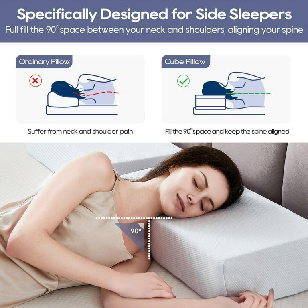
Your shoulder sits between your head and the mattress. Therefore, your pillow must fill that space without forcing your head upward.
The best pillow for neck support for a side sleeper is often taller and firmer than a back-sleeping pillow.
However, do not assume that “higher” always means “better.” A pillow that is too high can tilt your head away from the mattress.
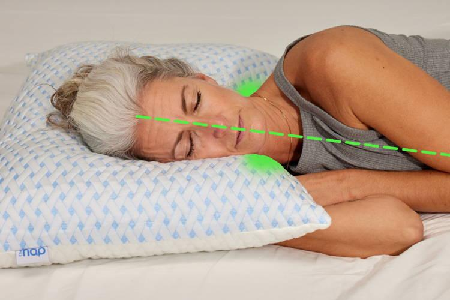
Try to keep your nose roughly in line with the center of your chest instead of pointing toward the mattress or ceiling.
Stomach Sleeping Creates a Special Challenge
Stomach sleeping can force your head to turn to one side for a long period.
That position can place extra stress on the neck.
Cleveland Clinic advises avoiding stomach sleeping when possible, particularly for people dealing with neck discomfort.
If you cannot change your position, a very thin pillow may reduce the amount your neck has to bend.
Best Pillow for Neck Support and Pillow Height
Height is one of the most important features to check.
Unfortunately, there is no universal measurement that works for every person.
A side sleeper with broad shoulders may need more loft than a smaller person with narrow shoulders. Likewise, a firm mattress may require a different pillow height than a soft mattress.
Cleveland Clinic explains that mattress firmness affects the amount of pillow height you need because your shoulder sinks differently into different mattresses.
Your Mattress Changes the Right Pillow
Think about your pillow and mattress as a team.
On a firm mattress, your shoulder usually sinks less. Therefore, you may need more pillow height.
On a soft mattress, your shoulder may sink farther into the surface. Consequently, a thinner pillow may work better.
This small detail can explain why a pillow feels perfect on one bed but uncomfortable on another.
Memory Foam Is Popular for a Reason
Memory foam can mold around your head and neck.
That can create a stable feeling compared with loose-fill pillows.
Some memory foam pillows use one solid piece. Others contain shredded foam that you can move around.
A solid foam pillow usually provides a more consistent shape. Meanwhile, shredded foam can allow some adjustment.
Cleveland Clinic notes that memory foam and contour designs can provide useful support, although the right choice still depends on the individual sleeper.
Latex Offers a Different Feel
Latex pillows tend to feel springier than traditional memory foam.
They can respond quickly when you move your head.
Cleveland Clinic specifically discusses latex as a supportive option and notes that it may feel cooler than some memory foam designs.
However, people with latex allergies should choose another material.
Best Pillow for Neck Support With Contours
A cervical contour pillow has a special shape.
Usually, the center area supports your head while a raised section supports the neck.
This design can help some back and side sleepers maintain a more natural position.
Still, a contour pillow may feel strange during the first few nights. Therefore, give yourself time to adjust rather than judging it after only a few minutes.
Adjustable Fill Gives You More Control
Adjustable pillows can be useful if you are unsure about the right height.
You can remove some filling if the pillow feels too high. Likewise, you can add filling if it feels too flat.
This option can be especially useful for side sleepers because shoulder width varies greatly from person to person.
It also reduces the risk of buying a pillow that is permanently the wrong height.
Best Pillow for Neck Support With Buckwheat Fill
Buckwheat pillows contain small hulls that move around inside the cover.
They can feel firm and supportive.
They also allow you to shape the pillow around your neck.
However, the filling can make noise when you move. Cleveland Clinic highlights this as one of the main drawbacks of buckwheat designs.
Therefore, light sleepers may prefer foam or latex.
Why Feather Pillows May Not Work
Feather pillows feel soft and fluffy.
However, they can compress and shift during the night.
Cleveland Clinic notes that feather pillows may provide less stable neck support because the filling moves under pressure.
That does not mean every feather pillow is bad. Instead, it means people who need steady support may prefer a more stable material.
Best Pillow for Neck Support and Firmness
Firmness matters, but very firm does not automatically mean better.
A pillow should support your neck without creating pressure.
If your head barely sinks into the pillow, it may feel hard. If your head sinks almost completely through it, it may not provide enough support.
Aim for balanced support.
Soft Pillows Can Still Work
Soft pillows are not always unsuitable.
Some people simply prefer a softer surface.
However, the pillow still needs enough structure underneath your head.
The key question is not “Is this pillow soft?” Instead, ask, “Does this pillow keep my head and neck in a comfortable, neutral position?”
Best Pillow for Neck Support and Shoulder Width
Your shoulders can change your pillow needs.
A person with wider shoulders may create a larger gap between the head and mattress while sleeping on the side.
Consequently, that sleeper may need a higher pillow.
A person with narrow shoulders may need less height.
This is one reason why advertised pillow height should serve as a starting point rather than a final answer.
A Simple Pillow Alignment Test
You can test your pillow without buying expensive equipment.
Lie in your normal sleeping position.
Then ask someone to look at your head and neck from behind.
Your head should not noticeably tilt toward the mattress or ceiling.
For back sleeping, your chin should not be pushed strongly toward your chest.
This simple check follows the basic principle of keeping the neck in a neutral position.
Best Pillow for Neck Support: A 60-Second Home Test
Try this tonight.
Place your usual pillow under your head. Relax your shoulders. Then notice whether your neck feels stretched, compressed, or naturally supported.
Next, try a folded towel under or inside the pillowcase to make a small height adjustment.
If a small change makes your neck feel more natural, pillow height may be your main problem.
Do not use a towel as a permanent solution if it creates pressure or discomfort.
The Pillowcase Can Affect Comfort
The inside of a pillow matters most for support, but the cover still matters.
A breathable cover may feel better if you sleep hot.
A washable cover can also help with regular cleaning.
Therefore, look for a removable cover that you can wash according to the manufacturer’s instructions.
Best Pillow for Neck Support for Hot Sleepers
If you wake up sweaty, material becomes more important.
Traditional memory foam can feel warm to some sleepers.
Latex, ventilated foam, breathable covers, and some shredded-fill designs may provide a different sleeping experience.
However, cooling claims vary by product.
Do not choose a pillow only because its marketing says “cooling.” Check the actual material and construction.
How Pillow Shape Affects Neck Comfort
Shape changes how support reaches your neck.
A flat pillow spreads pressure differently from a contour pillow.
A shredded pillow allows more adjustment.
A cervical pillow creates a specific support zone.
Therefore, the best shape depends on how you sleep and how much structure your neck needs.
Best Pillow for Neck Support for Combination Sleepers
Combination sleepers move between positions.
You might fall asleep on your side and wake up on your back.
In that case, an adjustable pillow can be especially useful.
A medium-height pillow with adjustable filling can give you more flexibility than a fixed-height design.
A cervical pillow with two different contour heights may also suit some combination sleepers.
What Makes a Pillow a Good Buy?
Do not judge a pillow by appearance alone.
Instead, check:
- Correct height
- Suitable firmness
- Stable neck support
- Breathable materials
- Washable cover
- Adjustable filling when possible
- Return or trial period
- Clear material information
- Good construction
A return policy can be especially valuable because pillow comfort is personal.
Best Pillow for Neck Support: Advantages
A properly matched pillow can offer several benefits.
First, it can help maintain better head and neck alignment during sleep.
Second, it may reduce the awkward bending that can contribute to morning stiffness.
Third, a comfortable pillow may help you settle into a better sleeping position.
Fourth, adjustable designs can make it easier to personalize support.
Mayo Clinic recommends keeping your head and neck aligned with your body while sleeping.
Best Pillow for Neck Support: Disadvantages
Every pillow type has drawbacks.
Memory foam may feel warm.
Latex may feel too springy for some people.
Buckwheat may make noise.
Feather pillows may lose shape.
Contour pillows may take time to get used to.
Adjustable pillows may require repeated testing.
Therefore, there is no perfect pillow for everyone.
Real-Life Example: The Side Sleeper
Consider a common example.
A side sleeper buys a very soft, low pillow because it feels comfortable in the store.
After several nights, the sleeper notices morning neck stiffness.
The problem may not be the softness itself. Instead, the pillow may allow the head to drop toward the mattress.
The sleeper then tries a slightly higher, firmer pillow and finds that the head stays more level.
This example shows why pillow height should match sleep position.
Case Study: What Cleveland Clinic Experts Recommend
Cleveland Clinic’s guidance gives us a useful real-world framework.
Its experts recommend keeping the neck parallel to the mattress rather than allowing it to bend sharply. They also discuss cervical contour pillows, foam options, latex, buckwheat, and the effect of mattress firmness.
The important lesson is simple: do not buy a pillow because a label says “orthopedic.”
Buy based on alignment, comfort, sleeping position, and fit.
Expert Advice From Mayo Clinic
Mayo Clinic recommends maintaining healthy head and neck alignment during sleep.
It also suggests back sleeping with appropriate support for some people experiencing neck discomfort.
In addition, Mayo Clinic recommends good daytime posture and regular movement because sleep is only one part of neck health.
So, even the best pillow for neck support cannot fix every cause of neck pain.
Best Pillow for Neck Support and Daytime Habits
Your neck does not only work at night.
Hours spent looking down at a phone or sitting at a poorly arranged desk can also contribute to neck discomfort.
Mayo Clinic recommends keeping screens near eye level and taking regular breaks from prolonged computer or device use.
Therefore, improve your daytime posture along with your pillow.
Do You Need an Orthopedic Pillow?
The word “orthopedic” sounds impressive.
However, it does not automatically mean the pillow will suit you.
A well-designed cervical pillow can be useful, but the shape must fit your body and sleeping position.
Spine-health describes cervical pillows as pillows with a raised neck-support area and a lower head area.
Therefore, focus on the actual design rather than the marketing label.
How to Break In a New Pillow
A new pillow can feel unusual.
Your neck may be accustomed to your old pillow, even if the old pillow was not ideal.
Try the new pillow for several nights if it feels comfortable and does not cause worsening pain.
However, do not force yourself to continue if you develop significant discomfort.
A pillow should support you, not make you feel worse.
When to Replace Your Pillow
A pillow can lose shape over time.
Watch for:
- Permanent lumps
- Flattening
- Uneven filling
- Sagging
- Broken foam
- Persistent morning stiffness
- Loss of support
Cleveland Clinic published updated guidance in 2026 explaining that poor pillow support can contribute to muscle tension and morning discomfort.
Best Pillow for Neck Support and Budget
You do not need the most expensive pillow.
A costly pillow can still be the wrong height.
Meanwhile, a reasonably priced adjustable pillow may fit your body better.
Therefore, spend money on useful features rather than branding.
Prioritize support, materials, washable construction, and a reasonable return policy.
How to Compare Pillow Materials
| Pillow type | Support | Cooling | Adjustability | Main advantage | Main drawback |
| Memory foam | High | Medium | Low–High | Stable shape | May feel warm |
| Latex | High | Medium–High | Low | Springy support | Not suitable for latex allergy |
| Shredded foam | Medium–High | Medium | High | Easy height adjustment | Can shift |
| Buckwheat | High | High | High | Airflow and shaping | Can make noise |
| Feather | Low–Medium | High | Medium | Soft feel | Can flatten |
| Polyester fiber | Low–Medium | Medium | Low | Affordable | Can lose shape |
| Cervical contour foam | High | Medium | Low | Designed for neck support | Takes adjustment |
The table gives a general comparison. Actual performance varies by design and construction.
A Simple Buying Checklist
Before buying, ask yourself these questions:
- Do I sleep on my back, side, stomach, or a mix?
- Is my mattress firm or soft?
- Are my shoulders narrow, medium, or broad?
- Do I sleep hot?
- Do I like soft or firm support?
- Can I adjust the pillow height?
- Does the manufacturer provide a return period?
- Can I wash the cover?
These questions can narrow your choices quickly.
Best Pillow for Neck Support: Common Mistakes
Many shoppers make the same mistakes.
They choose a pillow that is too tall.
They buy based on softness.
They ignore mattress firmness.
They select a pillow without considering sleep position.
They also keep using an old pillow even after it loses its shape.
Avoid these mistakes, and your search becomes much easier.
When a Pillow Is Not the Whole Answer
Neck pain can have many causes.
A pillow may contribute to discomfort, but it may not be the main cause.
Poor posture, muscle strain, injury, prolonged screen use, and other problems can also cause neck pain.
Cleveland Clinic recommends medical evaluation when symptoms require professional attention.
Therefore, do not treat a pillow as a cure for an underlying medical problem.
When Should You Talk to a Doctor?
Seek professional advice if neck pain is severe, persistent, follows an injury, or comes with concerning symptoms.
Cleveland Clinic notes that a stiff neck is often temporary, but some causes require medical care.
Likewise, Mayo Clinic provides professional guidance for diagnosis and treatment when neck pain does not improve with simple care.
Best Pillow for Neck Support: External Resources
For trustworthy information, use medical and professional sources rather than relying only on product reviews.
- Mayo Clinic: Its neck-pain guidance covers sleep position, alignment, posture, and everyday habits. Mayo Clinic neck pain guidance
- Cleveland Clinic: Its pillow guide explains pillow height, materials, mattress firmness, and sleeping position. Cleveland Clinic pillow guide
- Spine-health: Its peer-reviewed pillow guidance explains pillow height and support for back and side sleepers. Spine-health pillows for neck pain
These resources are useful starting points, especially if you have recurring neck discomfort.
Best Pillow for Neck Support: Quick Decision Guide
Choose lower support if you mostly sleep on your back.
Choose higher support if you mostly sleep on your side.
Choose very low support if you cannot avoid stomach sleeping.
Choose adjustable fill if you change positions often.
Choose memory foam or latex if you want a more stable feel.
Choose buckwheat if you like firm, adjustable support and do not mind some noise.
Most importantly, choose the pillow that keeps your head and neck in a natural position.
Best Pillow for Neck Support:FAQs
FAQ 1: What is the best pillow for neck support?
The best pillow for neck support is one that keeps your head and neck aligned with your spine. Your sleep position, mattress, body size, and comfort all affect the right choice.
FAQ 2: Is memory foam good for neck support?
Yes. Memory foam can provide stable support and may conform to your head and neck. However, some people find it warm.
FAQ 3: Is a cervical pillow better for neck pain?
A cervical pillow can help some people because its shape provides a dedicated neck-support area. However, the design must fit your sleeping position.
FAQ 4: What pillow height is best for side sleepers?
Side sleepers often need a higher pillow than back sleepers. The pillow should fill the gap created by the shoulder without pushing the head upward.
FAQ 5: What pillow is best for back sleepers?
Back sleepers often do well with a lower pillow that supports the natural neck curve without pushing the head too far forward.
FAQ 6: Should your neck be straight while sleeping?
Your neck should stay in a comfortable, neutral alignment with the rest of your spine. It should not bend sharply forward, backward, or sideways.
FAQ 7: Can a pillow cause neck pain?
Yes. A pillow that is too high, too low, too soft, or poorly matched to your sleep position may contribute to morning neck discomfort.
FAQ 8: Is a firm pillow better for your neck?
Not necessarily. Firmness should match your needs. A pillow can be firm but still too high or too low.
FAQ 9: Are soft pillows bad for neck support?
No. A soft pillow can work if it provides enough support and keeps your head properly aligned.
FAQ 10: Is latex better than memory foam?
Neither material is automatically better. Latex usually feels more springy, while memory foam often feels more conforming.
FAQ 11: Are orthopedic pillows worth it?
They can be useful, but the word “orthopedic” does not guarantee a good fit. Check the actual shape, height, firmness, and return policy.
FAQ 12: Can changing my pillow stop neck pain?
A suitable pillow may reduce sleep-related strain, but neck pain can have many causes. Persistent pain deserves professional attention.
FAQ 13: How often should I replace a pillow?
Replace it when it loses its shape, becomes permanently flat or lumpy, or stops providing comfortable support. The exact timing varies by material and use.
FAQ 14: Is a thick pillow good for side sleepers?
A thicker pillow can work for some side sleepers, especially those with wider shoulders. However, excessive height can tilt the head.
FAQ 15: What is better for neck support, one-piece or shredded foam?
One-piece foam usually gives consistent support. Shredded foam offers more adjustment. Your preference and sleeping position should guide the decision.
FAQ 16: Can I use a towel to improve pillow support?
A small folded towel can temporarily change pillow height and help you test whether additional support feels better. Do not use it if it creates pressure or discomfort.
FAQ 17: Is sleeping without a pillow good for neck pain?
It depends on your sleeping position and body. Most back and side sleepers need some head support to maintain alignment.
FAQ 18: Should stomach sleepers use a pillow?
Stomach sleepers generally need very little head elevation because a thick pillow can increase neck rotation and bending. Changing to side or back sleeping may be more comfortable.
FAQ 19: What should I look for when buying a neck-support pillow?
Look for suitable height, stable support, appropriate firmness, breathable materials, a washable cover, and a good return policy.
FAQ 20: How do I know if my pillow is the right one?
You should be able to lie comfortably without your head tilting sharply up or down. You should also wake without new or worsening neck discomfort.
Best Pillow for Neck Support: The Bottom Line
The best pillow for neck support is not necessarily the most expensive, thickest, softest, or most heavily advertised option.
Instead, choose based on alignment first.
Back sleepers often need a lower pillow. Side sleepers usually need more height. Stomach sleepers generally need very little height. Combination sleepers may benefit from adjustable designs.
Also, remember your mattress. A firm mattress and soft mattress create different spaces between your head and the bed.
Most importantly, do not ignore ongoing neck pain. A good pillow can improve your sleeping setup, but it cannot solve every medical or posture problem.
The smartest approach is simple: match your pillow to your sleeping position, keep your neck neutral, test the height, and give yourself enough time to find what feels naturally supportive.