
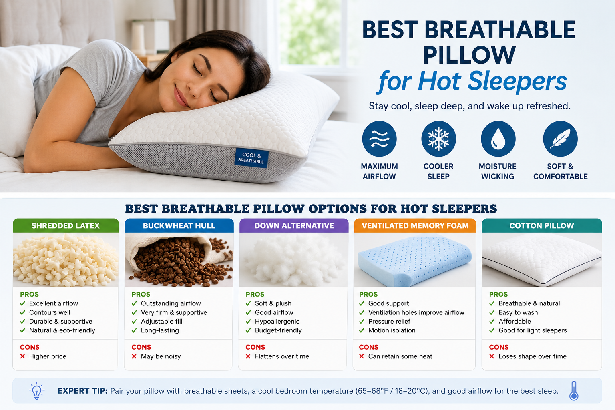
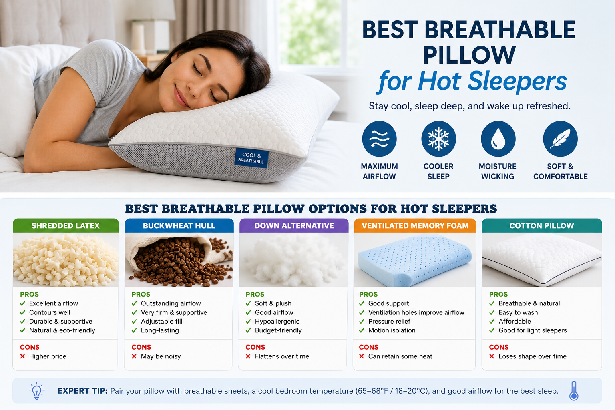
Best breathable pillow for hot sleepers choices usually have three things: an airy fill, a breathable outer cover, and enough space for air to move around your head.
For most warm sleepers, shredded latex is one of the strongest choices because it combines airflow, support, and a springy feel. Buckwheat is another excellent option if you like a firmer pillow. Meanwhile, breathable down-alternative fill can suit people who want a softer feel.
Sleep Foundation’s current pillow research says fill and shell materials both affect temperature control. Its testing found shredded latex, down alternative, and buckwheat among the better-performing cooling fills, while solid memory foam tends to hold more heat.
So, there is no single pillow that wins for everyone. Your sleeping position, room temperature, body size, pillow height, and personal comfort all matter.
Why Hot Sleepers Need a Different Pillow
The best breathable pillow for hot sleepers should not simply feel cold when you first touch it.
Instead, it should help heat escape while you sleep.
Your head and neck stay against the pillow for many hours. Therefore, a dense pillow can create a warm pocket around your face and neck. If the cover also blocks airflow, the problem can become worse.
A good cooling pillow takes a different approach. It allows air to move through or around the filling. Also, a moisture-friendly cover can help manage sweat.
Sleep Foundation notes that breathable materials such as cotton, bamboo-derived fabrics, and Tencel can help warm sleepers. It also warns that some polyester covers can reduce airflow and feel warmer.
What Makes the Best Breathable Pillow for Hot Sleepers?
When shopping for the best breathable pillow for hot sleepers, look beyond marketing words such as “ice cold” or “Arctic cooling.”
Instead, check the actual construction.
Look for:
- Shredded or ventilated filling
- Natural latex
- Buckwheat hulls
- Breathable cotton
- Tencel or moisture-wicking covers
- Adjustable filling
- A washable outer cover
- Good airflow
- Correct pillow height
- Suitable firmness
A pillow can have cooling gel and still feel warm if the main structure blocks airflow. Therefore, construction matters more than a flashy cooling label.
Shredded Latex Creates Useful Air Channels
The best breathable pillow for hot sleepers often uses shredded latex because the pieces leave small spaces between them.
Those spaces allow air to move through the pillow.
Latex also has a springy feel. Therefore, your head does not sink as deeply into it as it might with some soft memory foam pillows.
Sleep Foundation describes latex pillows as breathable and durable. It also notes that shredded latex is more flexible, while solid latex provides stronger shape retention.
For warm sleepers who want support without a heavy, sinking feeling, shredded latex deserves serious attention.
Buckwheat Hulls Offer Natural Airflow
The best breathable pillow for hot sleepers does not always need foam or special cooling gel.
Buckwheat pillows use the hard outer hulls of buckwheat seeds. The hulls naturally create many small air gaps.
That design gives the pillow excellent ventilation. Sleep Foundation specifically notes that gaps between buckwheat hulls allow strong airflow and can provide notable cooling.
However, buckwheat feels much firmer than most fluffy pillows. It also makes a gentle rustling sound when you move.
Therefore, this choice works best for people who enjoy firm, adjustable support.
Down-Alternative Fill Keeps Things Soft
For people who dislike firm pillows, the best breathable pillow for hot sleepers may use down-alternative fibers.
These fibers can create a fluffy, soft surface without using animal down.
Sleep Foundation’s 2026 bedding research identifies plant-based and down-alternative fills as options that can retain little body heat, especially when paired with breathable cotton covers.
However, soft fiber pillows can flatten over time. Therefore, you may need to fluff them regularly.
Memory Foam Is Not Always the Enemy
The best breathable pillow for hot sleepers can sometimes include memory foam, but construction matters.
Solid memory foam generally holds more heat because it has fewer open spaces for air movement.
Shredded memory foam can perform better because air can move between the pieces. Ventilated designs can also help.
Some manufacturers add gel, graphite, copper, or other materials. However, do not assume these additions automatically make a pillow cool.
Sleep Foundation notes that memory foam can trap heat, although gel or other cooling features may be added to improve temperature control.
The Pillow Cover Can Change Everything
The best breathable pillow for hot sleepers needs a good outer cover.
Think of the cover as the pillow’s shirt.
A thick synthetic cover can reduce airflow. On the other hand, cotton, Tencel, and other breathable fabrics can make the surface feel less stuffy.
Also, look for removable covers. You can wash them more easily, which matters if you sweat during sleep.
A breathable pillow with a poor cover may perform worse than expected. Therefore, always check both the filling and the cover.
Tencel Covers Help Manage Moisture
Tencel has become popular in cooling bedding because it can feel smooth and help manage moisture.
For a warm sleeper, that matters because heat and sweat often arrive together.
A moisture-friendly cover does not make your bedroom cold. Instead, it can help the surface feel drier and more comfortable.
Sleep Foundation includes Tencel among breathable, moisture-wicking bedding materials worth considering for warm sleepers.
Cotton Remains a Simple Cooling Choice
The best breathable pillow for hot sleepers does not have to use an expensive high-tech fabric.
Cotton remains a practical choice.
It is widely available, breathable, and easy to wash. Organic cotton can also appeal to people who prefer natural materials.
However, cotton itself does not guarantee a cool pillow. A thick cotton shell wrapped around dense foam can still feel warm.
Therefore, always judge the entire pillow rather than one material.
Side Sleepers Need More Than Cooling
A side sleeper searching for the best breathable pillow for hot sleepers should consider height just as carefully as temperature.
Your shoulder creates space between your head and mattress.
Therefore, side sleepers often need a thicker pillow to keep the neck in a comfortable position. Sleep Foundation generally recommends higher-loft pillows for side sleepers.
A pillow that feels wonderfully cool but leaves your head tilted downward is not a good long-term choice.
Mayo Clinic also recommends keeping the head and neck aligned with the body while sleeping.
Back Sleepers Need Balanced Loft
For back sleepers, the best breathable pillow for hot sleepers should support the neck without pushing the head too far forward.
A medium-height pillow often works well.
Sleep Foundation says back sleepers commonly prefer mid-loft pillows around 3 to 5 inches, although body size and pillow compression can change the ideal height.
Therefore, do not choose a thick pillow simply because you want more cooling material.
Stomach Sleepers Usually Need Less Height
A stomach sleeper choosing the best breathable pillow for hot sleepers should usually look for a low profile.
A thick pillow can push the head upward and create an uncomfortable neck angle.
A thin, soft pillow may work better.
Some stomach sleepers even prefer very little head elevation. However, comfort and alignment should guide the final decision.
Cleveland Clinic also advises avoiding positions that twist the neck into awkward angles.
Combination Sleepers Need Flexibility
The best breathable pillow for hot sleepers for a combination sleeper should adapt when you change positions.
Adjustable shredded pillows are useful here.
You can remove some filling when sleeping on your back. Then, you can add more fill if you spend the night on your side.
This flexibility can save you from buying several pillows.
Hot and Humid Rooms Need More Airflow
The best breathable pillow for hot sleepers becomes even more important in humid weather.
Humidity can make sweat evaporate more slowly. As a result, your skin may feel warmer and stickier.
A breathable pillow cannot control your entire bedroom. Still, it can reduce the warm feeling around your head.
For hot climates, combine the pillow with lightweight sheets, a fan, good ventilation, and suitable room temperature.
A Cooler Bedroom Improves the Whole Setup
Even the best breathable pillow for hot sleepers cannot overcome an extremely hot bedroom.
Sleep Foundation reports that many experts recommend a bedroom around 65 to 68°F, although personal comfort varies.
If that temperature is not practical where you live, focus on reducing heat as much as you reasonably can.
Use a fan, improve ventilation, reduce heavy bedding, and choose light sleepwear.
A Real-Life Example: The Side Sleeper
Consider a fictional but realistic example.
Sarah sleeps on her side and wakes with a sweaty neck. She buys a very thin cooling pillow because she thinks thinner means cooler.
However, her neck bends downward.
She later switches to a breathable shredded-latex pillow with adjustable height. Now she can keep enough filling to support her shoulder gap while still allowing air through the pillow.
This shows an important lesson: cooling and support must work together.
A Real-Life Example: The Back Sleeper
John sleeps on his back in a warm bedroom.
He originally uses a thick solid memory foam pillow. It feels supportive at bedtime, but he wakes during the night feeling warm.
He switches to a ventilated latex pillow with a breathable cover.
The new pillow does not magically lower his body temperature. However, its more open structure reduces the stuffy feeling around his head.
That is a realistic goal for cooling bedding.
Case Study: Why Material Choice Matters
A useful comparison comes from Sleep Foundation’s pillow testing methods.
Its researchers assess temperature control by using physical sleep tests and thermal sensors. They also examine how pillow materials behave during real use.
Their findings show a clear pattern: shredded latex and buckwheat can provide strong airflow, while dense solid memory foam tends to hold more heat.
This gives shoppers a practical starting point.
Case Study: A Current Latex Option
The best breathable pillow for hot sleepers category includes ventilated latex designs.
For example, Sleep Foundation’s current 2026 testing highlights the Sijo CloudSupport Pillow for temperature regulation. It uses ventilated Talalay latex and a moisture-wicking Tencel cover.
That combination demonstrates why both the core and cover matter.
The pillow does not rely on one cooling trick. Instead, it combines airflow with moisture management.
Expert Advice on Neck Alignment
Cleveland Clinic expert Andrew Bang recommends keeping the neck parallel with the mattress rather than bending it sharply upward or downward.
That advice matters when shopping for the best breathable pillow for hot sleepers.
Cooling should never come before proper support.
If your pillow is too high, too low, or too soft, you may wake with stiffness even if you stayed cool.
The Best Breathable Pillow for Hot Sleepers: Comparison Chart
Here is a simple comparison to help you narrow your choices:
| Pillow type | Airflow | Support | Softness | Best for | Main drawback |
| Shredded latex | Excellent | High | Medium | Hot sleepers | Can cost more |
| Ventilated latex | Very good | High | Medium | Side/back sleepers | Latex feel |
| Buckwheat | Excellent | Very high | Firm | Firm-pillow fans | Rustling noise |
| Down alternative | Good | Medium | Very soft | Plush comfort | Can flatten |
| Shredded memory foam | Moderate | High | Medium | Adjustable support | May still feel warm |
| Solid memory foam | Low to moderate | High | Medium | Pressure relief | Heat retention |
| Cotton-filled | Good | Low to medium | Soft | Natural-material fans | Loses loft |
| Kapok | Good | Medium | Soft | Fluffy feel | Needs fluffing |
How to Pick the Right Firmness
The best breathable pillow for hot sleepers should match your sleeping position.
Side sleepers usually need more height and support.
Back sleepers often need medium height.
Stomach sleepers generally need a thinner profile.
Your body weight also affects how much a pillow compresses. Sleep Foundation notes that heavier sleepers may need more loft to maintain support.
Look for Adjustable Filling
Adjustability makes the best breathable pillow for hot sleepers more useful.
If the pillow comes with removable filling, you can change the height yourself.
That feature helps when you are unsure whether you need a low, medium, or high loft.
It also helps combination sleepers.
Instead of accepting the manufacturer’s fixed height, you can create a setup that better matches your body.
Don’t Trust the Word “Cooling” Alone
Many products use the word “cooling.”
However, cooling can mean several different things.
Some pillows feel cool when you first touch them. Others use materials that encourage airflow. Some use phase-change materials that absorb and release heat.
Therefore, check the construction.
Ask:
- What is inside?
- Can air move through it?
- What is the cover made from?
- Does the pillow trap moisture?
- Can I adjust the height?
- Can I wash the cover?
These questions reveal more than a marketing slogan.
Advantages of a Breathable Pillow
The best breathable pillow for hot sleepers can offer several useful advantages.
Main benefits
- Better airflow
- Less stuffy feeling
- Better comfort in warm weather
- Moisture-friendly covers
- More comfortable sleep surface
- Support options for different positions
- Adjustable designs
- Natural-material choices
- Reduced need to flip the pillow repeatedly
However, remember that a pillow is only one part of your sleep environment.
Disadvantages You Should Know
The best breathable pillow for hot sleepers still has limitations.
First, natural latex can cost more than basic polyester pillows.
Second, buckwheat can feel hard.
Third, some latex pillows may not suit people with latex allergies.
Fourth, down-alternative pillows may need frequent fluffing.
Finally, no pillow can guarantee that you will never sweat at night.
That last point matters. Your room, clothing, bedding, mattress, activity, and personal temperature regulation all influence how warm you feel.
What About Gel Cooling Pillows?
Gel can help some pillows feel cooler at first.
However, gel does not automatically create strong airflow.
A pillow with a thick foam core can still retain heat even when it has a gel layer.
Therefore, if you want the best breathable pillow for hot sleepers, prioritize airflow and breathable materials before choosing a gel feature.
Should You Choose Natural Materials?
Natural materials can be attractive for warm sleepers.
Latex, cotton, wool, buckwheat, and kapok all have different temperature and comfort qualities.
Sleep Foundation describes natural latex as breathable and durable, while buckwheat provides strong airflow through gaps between the hulls.
Still, natural does not automatically mean better.
The design, thickness, cover, and firmness all matter.
What About Pillow Certifications?
If you choose a foam pillow, check whether the manufacturer provides credible material information.
CertiPUR-US says certified flexible polyurethane foam is tested for content, emissions, and durability by independent accredited laboratories. Its certification includes limits on certain chemicals and low VOC emissions.
Certification does not tell you whether a pillow feels comfortable or cool.
However, it can give you additional information about the foam used inside.
How Often Should You Replace a Pillow?
The best breathable pillow for hot sleepers cannot stay fresh forever.
Pillows collect sweat, oils, skin particles, and dust over time.
CertiPUR-US notes that sleep experts commonly recommend replacing sleep pillows every one to two years because old pillows can flatten and collect unwanted material.
Replace yours sooner if it has:
- Permanent lumps
- A strong odor
- Visible damage
- Major loss of height
- Poor neck support
- Stains that cannot be cleaned
How to Keep Your Pillow Cooler
Even the best breathable pillow for hot sleepers needs help.
Try these simple steps:
- Use a breathable pillowcase.
- Avoid thick polyester covers.
- Wash the cover regularly.
- Keep your room ventilated.
- Use a fan when suitable.
- Reduce heavy blankets.
- Choose lightweight sleepwear.
- Avoid stacking several pillows.
- Keep the pillow away from direct sunlight during the day.
Small changes can make a noticeable difference.
Washing and Care Matter
A breathable pillow that becomes dirty and compressed may not feel good for long.
Check the manufacturer’s care instructions before washing.
Many pillows have washable covers but not washable cores.
For example, some current latex pillow designs separate the outer cover from the internal filling, making regular cleaning easier.
Never assume that every pillow can go into a washing machine.
A Simple Cooling Bedroom Formula
You can build a strong cooling setup without spending a fortune.
Start with:
Breathable pillow + cotton or Tencel cover + lightweight sheets + fan + reduced bedding + comfortable room temperature.
The best breathable pillow for hot sleepers works best as part of this larger system.
If your mattress traps a lot of heat, changing only your pillow may not solve the problem.
Common Shopping Mistakes
People often make five mistakes.
First, they buy based only on the word “cooling.”
Second, they ignore pillow height.
Third, they choose a very soft pillow when they need support.
Fourth, they forget about the cover.
Fifth, they expect a pillow to fix an overheated bedroom.
Avoid these mistakes and your chances of finding a comfortable pillow improve.
Budget Choice vs Premium Choice
The best breathable pillow for hot sleepers does not have to be the most expensive one.
Budget approach
Look for:
- Cotton cover
- Breathable fiber fill
- Adjustable fill
- Simple construction
Premium approach
Consider:
- Natural latex
- Ventilated Talalay latex
- High-quality Tencel cover
- Adjustable chambers
- Strong warranty
- Sleep trial
A higher price can buy better materials, but it does not guarantee better personal comfort.
The Best Choice for Side Sleepers
For side sleepers, I would prioritize:
- Adjustable shredded latex
- Ventilated latex
- Firm buckwheat
- Supportive shredded foam with airflow
The key is enough height.
Your pillow should fill the space between your head and mattress without forcing your neck upward.
The Best Choice for Back Sleepers
Back sleepers can consider:
- Medium-loft ventilated latex
- Adjustable shredded latex
- Breathable down alternative
- Lower-profile shredded foam
The goal is a neutral neck position.
Mayo Clinic recommends keeping your head and neck aligned with your body during sleep.
The Best Choice for Stomach Sleepers
Stomach sleepers generally need less filling.
Therefore, consider:
- Low-loft down alternative
- Thin cotton pillow
- Soft, adjustable pillow
- Very low-profile breathable design
If a pillow pushes your head too high, reduce the filling or choose a thinner model.
The Best Choice for People Who Sweat
If sweating is your biggest issue, prioritize moisture management.
Look for a breathable shell made from cotton or Tencel.
Then choose an airy fill such as shredded latex or buckwheat.
Also, wash your pillowcase frequently.
A cooling surface becomes less useful when sweat and body oils build up.
The Best Choice for Allergy Concerns
If allergies matter to you, check the exact materials before buying.
Natural latex can resist mold, mildew, and dust mites, according to Sleep Foundation.
However, latex is not suitable for everyone.
If you know you react to latex, choose a different material and follow your healthcare professional’s advice.
The Best Choice for Humid Summers
In hot, humid weather, airflow becomes especially valuable.
A buckwheat or shredded-latex pillow can provide open spaces for air movement.
Pair it with a lightweight pillowcase and breathable sheets.
Also, keep your room ventilated when possible.
A fan can improve air movement around the sleeping area, although direct strong airflow may bother some people.
FAQs About Cooling Pillows
- What is the best breathable pillow for hot sleepers?
Shredded latex, ventilated latex, and buckwheat are strong choices because their designs encourage airflow.
- Is latex cooler than memory foam?
Generally, breathable latex tends to sleep cooler than dense solid memory foam.
- Are buckwheat pillows good for hot sleepers?
Yes. The gaps between buckwheat hulls create excellent airflow.
- Is memory foam good for hot sleepers?
It can work, especially in shredded or ventilated designs, but dense memory foam often retains more heat.
- What pillow material stays coolest?
Airy materials such as shredded latex and buckwheat are among the strongest choices for airflow.
- Is a bamboo pillow really cooler?
The word bamboo alone does not guarantee cooling. Check the actual fabric and filling.
- Does a cooling pillow stop night sweats?
No. It may improve comfort, but sweating can have many causes.
- What pillow is best for side sleepers?
A higher-loft pillow often works well because side sleepers need more space filled between the shoulder and head.
- What pillow is best for back sleepers?
A medium-loft pillow with good neck support is often a useful starting point.
- What pillow is best for stomach sleepers?
A thin, soft pillow usually works better than a thick one.
- Is Tencel good for hot sleepers?
Yes. Tencel is commonly used for breathable and moisture-wicking bedding.
- Is cotton good for cooling?
Cotton is breathable and practical, especially when used as a pillow cover.
- Should hot sleepers use a firm pillow?
Firmness depends on your sleeping position and personal needs. Cooling alone should not determine firmness.
- Are gel pillows actually cool?
Some can feel cool, but gel does not automatically mean excellent airflow.
- How do I make my pillow cooler?
Use a breathable pillowcase, improve airflow, reduce heavy bedding, and keep the bedroom comfortably cool.
- How often should I wash my pillowcase?
Wash it regularly, especially if you sweat heavily. Follow the fabric’s care instructions.
- How often should I replace my pillow?
Many experts suggest replacing pillows around every one to two years, depending on condition.
- Can a pillow cause neck pain?
Yes. A pillow that pushes your neck too high or allows it to bend too far can create discomfort. Cleveland Clinic recommends keeping the neck aligned.
- Is an expensive cooling pillow always better?
No. A reasonably priced breathable pillow can work very well if its height, firmness, and materials suit you.
- What should I check first when buying a cooling pillow?
Check the filling, airflow, cover material, loft, firmness, washing instructions, trial period, and warranty.
Final Buying Checklist
Before buying the best breathable pillow for hot sleepers, use this quick checklist:
☐ Is the filling naturally breathable?
☐ Can air move through the pillow?
☐ Is the cover breathable?
☐ Does it manage moisture?
☐ Is the height right for your sleep position?
☐ Can you adjust the filling?
☐ Can you wash the cover?
☐ Does the manufacturer clearly list materials?
☐ Does the pillow have a useful trial period?
☐ Does it provide enough neck support?
If you can answer “yes” to most of these questions, you are on the right track.
Conclusion
The best breathable pillow for hot sleepers should do more than feel cool for five minutes.
It should let air move, manage moisture, support your neck, and match your sleeping position.
For many people, shredded latex offers the best balance of airflow and support. Buckwheat makes a great choice for firm-pillow fans. Meanwhile, down-alternative fibers suit sleepers who want a soft and fluffy surface.
Most importantly, do not choose a pillow based on the word “cooling” alone.
Look at the fill, cover, loft, firmness, and construction.
Your bedroom matters too. Sleep Foundation recommends a generally cool sleeping environment, with many experts pointing to roughly 65–68°F as a useful range for many adults.
Finally, remember that the right pillow is personal. The coolest pillow on paper may not be the most comfortable pillow for your body. Start with breathable materials, then match the pillow to your sleep position and support needs.
External resources
- Sleep Foundation — Pillow Research Methodology
- Sleep Foundation — How to Shop for Pillows
- Sleep Foundation — Best Cooling Pillows of 2026
- Mayo Clinic — Sleeping Positions and Pillow Support
- Cleveland Clinic — Choosing a Pillow for Neck Support
- CertiPUR-US — How to Choose a Pillow