
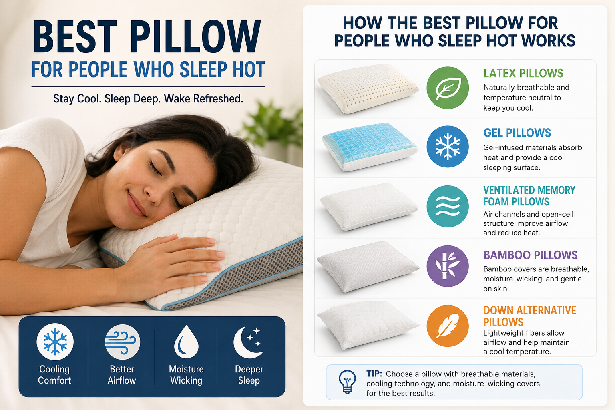
Best pillow for people who sleep hot is not simply the pillow that feels cold when you first touch it. Instead, the right pillow should help move heat away from your head, allow air to move through the filling, manage sweat, and still support your neck.
If you wake up with a damp pillow, flip it over several times during the night, or feel like your head is trapped in a warm cushion, your pillow may be part of the problem.
Fortunately, you have many better choices.
Latex, breathable down alternatives, buckwheat, cotton, Tencel, and some cooling foam designs can all work well. However, each material feels different. Therefore, you need to match the pillow with your sleeping position, body shape, comfort needs, and budget.
Sleep Foundation notes that both the pillow’s filling and outer cover affect temperature control. Its testing also found that shredded latex, down alternative, and buckwheat can perform well for cooling, while solid memory foam and down can hold more heat.
This guide explains everything in simple language. You will learn what makes a pillow cool, which materials work best, what hot sleepers should avoid, and how to choose the right loft and firmness.
Why Hot Sleepers Need a Different Pillow
Your head and neck stay against your pillow for many hours. As a result, heat can build up between your body and the pillow surface.
A normal pillow may feel comfortable at bedtime but become warm after several hours. Then, you may turn the pillow over, remove your blanket, or wake up feeling sweaty.
The best pillow for people who sleep hot should encourage airflow instead of creating a thick, sealed layer around your head.
Furthermore, your bedroom temperature matters too. Sleep Foundation recommends a bedroom temperature around 65°F for many sleepers, although personal comfort varies.
So, a cooling pillow cannot fix an extremely hot bedroom by itself. Instead, think of your pillow as one part of your complete sleep setup.
What Makes the Best Pillow for People Who Sleep Hot?
A cooling pillow usually has several useful features.
First, the filling should allow air to move through it. Second, the cover should breathe and handle moisture. Third, the pillow should provide enough support without becoming excessively thick and dense.
For example, shredded latex has small spaces between pieces that can help airflow. Buckwheat hulls also leave natural gaps around the filling. Down alternatives can feel light and airy when properly designed.
Meanwhile, some memory foam pillows use cooling gel, special covers, or ventilation channels. These features may help, but they do not automatically make every foam pillow cool.
Therefore, always look at the whole construction instead of trusting a word such as “cooling” on the package.
The Science Behind a Cool Sleep Surface
Your body naturally changes temperature during sleep. Your core temperature generally drops as you prepare for sleep and continues to change throughout the night.
However, a warm sleep environment can make this process harder.
When your pillow holds heat against your head, you may feel uncomfortable even when the rest of the room feels fine.
The best pillow for people who sleep hot should therefore reduce heat buildup at the point where your head touches the bed.
This does not mean the pillow must feel ice-cold. In fact, a pillow that feels cool for five minutes but becomes hot later may not be useful.
Long-lasting breathability matters more than a short cooling sensation.
How Pillow Filling Changes Temperature
Pillow filling plays a major role in temperature.
Dense foam can hold body heat because it surrounds the head closely. In contrast, materials with more open space can allow greater airflow.
Sleep Foundation’s pillow testing found that shredded latex, down alternative, and buckwheat performed well for temperature control, while solid memory foam and down tended to retain more heat.
Therefore, hot sleepers should look beyond softness.
A soft pillow can still sleep warm. Likewise, a firm pillow can still breathe well.
The goal is to find a balance between support, airflow, moisture control, and comfort.
Best Pillow for People Who Sleep Hot: Latex
Latex is one of the strongest choices for warm sleepers.
Natural latex has a springy feel. It does not wrap around your head as closely as traditional memory foam. That difference can help reduce the trapped, enclosed feeling that some hot sleepers dislike.
Talalay latex can feel especially airy because of its structure. Sleep Foundation describes latex as responsive and generally cooler than memory foam.
However, latex pillows often cost more than basic polyester pillows.
They can also feel bouncy. Therefore, someone who loves a deep, soft sink may need time to adjust.
For many people, though, latex offers an excellent mix of support, durability, and airflow.
Why Shredded Latex Can Be a Smart Choice
Shredded latex gives you an interesting advantage.
Instead of using one solid block, manufacturers place small latex pieces inside the pillow. Those pieces create spaces that can encourage airflow.
You can also move the filling around in some adjustable models.
That means you can make the pillow lower or higher depending on your sleep position.
The best pillow for people who sleep hot may use shredded latex because it combines breathability with adjustable support.
Sleep Foundation currently highlights the Saatva Latex Pillow as a cooling option and notes its shredded Talalay latex and breathable construction.
Still, do not assume every shredded latex pillow will feel identical. Cover fabric, fill amount, and pillow shape all matter.
Down Alternative: Soft Without Heavy Heat
Down alternative pillows can be a good budget option.
They usually contain synthetic fibers designed to imitate the soft feel of down. They can feel fluffy and light.
However, some polyester-based fills retain heat more than breathable natural materials.
Sleep Foundation notes that down alternatives can be affordable, washable, and animal-free, but polyester fiberfill may retain heat.
So, choose a down alternative pillow with a breathable outer cover and a light construction.
If you like a soft hotel-style pillow, this category deserves attention.
Buckwheat Hulls for Natural Airflow
Buckwheat pillows are unusual, but they can be excellent for hot sleepers.
Instead of foam or fiber, the pillow contains small buckwheat hulls.
These hulls leave gaps between one another. As a result, air can move through the pillow more easily than through many dense fills.
Buckwheat also allows you to shape the pillow around your head and neck.
However, there are drawbacks.
The pillow can feel firm and may make a rustling sound when you move.
Therefore, buckwheat works best for people who enjoy a supportive, structured pillow rather than a soft, fluffy one.
Best Pillow for People Who Sleep Hot: Cotton Covers
The cover matters more than many shoppers realize.
You may buy a breathable filling, but a thick synthetic cover can reduce the cooling benefit.
Cotton is popular because it is breathable, familiar, and widely available.
Sleep Foundation recommends breathable materials such as cotton, bamboo-derived fabrics, and Tencel for hot sleepers.
A cotton cover may not feel dramatically cold when you touch it. Instead, its benefit comes from allowing heat and moisture to move more naturally.
Therefore, check both the filling and the cover before buying.
Tencel and Other Moisture-Friendly Covers
Tencel is another fabric worth considering.
It feels smooth and can help manage moisture. That can make it useful if you sweat during sleep.
A pillow cover made from Tencel may feel less sticky than a thick synthetic fabric.
However, remember that fabric names alone do not guarantee perfect cooling.
The cover still needs to work with the pillow’s inner filling.
Therefore, a breathable cover paired with breathable filling creates a stronger cooling system than either feature alone.
Best Pillow for People Who Sleep Hot and Sweat
If you sweat heavily at night, moisture management becomes especially important.
A pillow that absorbs moisture and stays damp may become uncomfortable quickly.
Instead, look for removable, washable covers. Breathable cotton and moisture-friendly fabrics can also help.
Additionally, wash your pillowcase regularly.
Even the best pillow for people who sleep hot can feel unpleasant if the pillowcase collects sweat, skin oils, and moisture.
A simple washable cover can make a major difference.
For very sweaty sleepers, consider having two pillowcases so you can change one while the other is being washed.
Memory Foam: Helpful but Sometimes Warm
Memory foam is popular because it provides strong pressure relief.
It can mold around your head and neck, which many sleepers find comfortable.
However, that close fit can also create heat.
Sleep Foundation explains that memory foam often retains heat because of its dense, conforming structure. Some manufacturers add gel, copper, graphite, or ventilation features to improve temperature control.
Therefore, memory foam is not automatically a bad choice for hot sleepers.
Instead, choose ventilated or shredded foam if you prefer foam but struggle with heat.
Gel Cooling Foam: Does It Really Work?
Gel sounds impressive, but you should understand what it actually does.
A gel layer or gel infusion may help manage heat at the surface. However, the entire pillow still needs good airflow.
Some gel pillows can feel cool when you first lie down. Yet, after hours of use, the pillow may still become warm.
Sleep Foundation’s current gel-pillow testing notes that gel construction can suit hot sleepers, while also warning that not every gel pillow performs equally well.
Therefore, treat gel as one feature, not the entire answer.
Best Pillow for People Who Sleep Hot on Their Side
Side sleepers usually need more pillow height.
Your shoulder creates space between your head and mattress. A pillow needs to fill that space without pushing your head too far upward.
Sleep Foundation generally recommends higher-loft pillows for side sleepers.
The best pillow for people who sleep hot who sleep on their side should therefore provide both airflow and enough height.
Shredded latex can work well because you can often adjust the fill.
Talalay latex can also provide support without the deep, heat-trapping feel of some dense foam.
Best Pillow for People Who Sleep Hot on Their Back
Back sleepers normally need a medium-height pillow.
If the pillow is too high, it can push your head forward.
If it is too low, your neck may lack support.
A medium-loft latex pillow can offer a good balance.
A breathable shredded pillow can also work because you can move or remove some filling.
Therefore, focus on neutral neck alignment rather than choosing the thickest cooling pillow available.
Best Pillow for People Who Sleep Hot on Their Stomach
Stomach sleepers usually need a lower pillow.
A thick pillow can bend the neck upward and create an awkward position.
A thin, soft, breathable pillow may work better.
The best pillow for people who sleep hot who sleep on their stomach should therefore focus on low loft and airflow.
A thin down alternative or breathable fiber pillow can work well.
However, personal comfort still matters. If you naturally switch positions during the night, choose an adjustable design.
How Pillow Loft Affects Comfort
Loft means the height of the pillow.
Low loft is usually better for stomach sleepers.
Medium loft often works well for back sleepers.
Higher loft usually suits side sleepers.
However, your body size and mattress firmness also matter.
For example, a person with broad shoulders may need more height than someone with narrow shoulders.
Therefore, do not buy a pillow only because the box says “medium.”
Look for an adjustable design if you are unsure.
Firmness Matters More Than You Think
Firmness and cooling are separate issues.
A soft pillow can breathe well. A firm pillow can breathe well too.
However, the right firmness depends on your sleeping position and comfort needs.
Side sleepers often need more support. Back sleepers usually need balanced support. Stomach sleepers often prefer softer, thinner pillows.
Therefore, the best pillow for people who sleep hot is the one that keeps you comfortable without forcing your neck into an unnatural position.
Cooling should never replace proper support.
Best Pillow for People Who Sleep Hot With Neck Pain
If you experience neck discomfort, do not choose a pillow only because it claims to be cooling.
Your neck needs proper support.
Latex can be useful because it stays responsive instead of collapsing deeply.
Adjustable shredded pillows can also help because you can change the loft.
Sleep Foundation’s current side-sleeper testing includes Talalay latex options that scored well for temperature control and neck and shoulder comfort.
If neck pain continues despite changing your pillow, consider speaking with a qualified health professional.
What About Feather and Down Pillows?
Down and feather pillows can feel luxurious.
They are soft, fluffy, and easy to shape.
However, down provides natural insulation. That same quality that helps keep warmth in can make it less ideal for some hot sleepers. Sleep Foundation’s testing notes that down can retain heat.
Feather pillows can offer a firmer feel, but quills may sometimes poke through the cover.
Therefore, if you sleep hot, compare down with more breathable options before buying.
Best Pillow for People Who Sleep Hot on a Budget
You do not need to spend hundreds of dollars.
A simple breathable pillowcase paired with an affordable, washable pillow can work surprisingly well.
Look for:
- Breathable cotton covers
- Adjustable filling
- Shredded construction
- Machine-washable covers
- Moderate loft
- Good airflow
- A generous return period
The best pillow for people who sleep hot is not always the most expensive pillow.
Instead, focus on construction.
A Quick Comparison of Cooling Pillow Materials
| Pillow Material | Cooling | Support | Softness | Airflow | Price |
| Natural latex | Excellent | Excellent | Medium | Excellent | High |
| Shredded latex | Excellent | Excellent | Medium-soft | Excellent | High |
| Buckwheat | Excellent | Excellent | Firm | Excellent | Medium |
| Down alternative | Good | Medium | Soft | Good | Low-medium |
| Cotton | Good | Low-medium | Soft | Good | Low |
| Memory foam | Fair | Excellent | Medium-firm | Fair | Medium-high |
| Gel memory foam | Good | Excellent | Medium | Fair-good | Medium-high |
| Down | Fair | Medium | Very soft | Fair | High |
| Polyester fiber | Fair | Medium | Soft | Fair | Low |
This table gives you a starting point. However, construction varies between brands.
Best Pillow for People Who Sleep Hot: Key Features
When shopping, look for these features:
- Breathable filling
- Airflow-friendly construction
- Moisture-friendly cover
- Adjustable loft
- Removable cover
- Washable materials
- Good neck support
- Suitable firmness
- A reasonable trial period
- A clear return policy
Furthermore, check the manufacturer’s care instructions before buying.
A pillow that cannot be cleaned easily may become less pleasant over time.
Why Pillowcase Choice Can Change Everything
Sometimes the pillow is not the main problem.
Your pillowcase may trap heat.
A thick polyester case can feel warmer than lightweight cotton or other breathable fabrics.
Therefore, try changing the pillowcase before replacing an expensive pillow.
This is a low-cost experiment.
Use a lightweight, breathable case for several nights. Then compare how you feel.
If you notice less sweating, your pillow may not need replacement.
Best Pillow for People Who Sleep Hot in Humid Weather
Humidity creates a special challenge.
When the air feels damp, sweat does not evaporate as easily.
That can make your pillow feel warmer and wetter.
A breathable cover can help manage this problem, but room ventilation also matters.
Sleep Foundation recommends controlling bedroom humidity and improving ventilation as part of a cooler sleep environment.
Therefore, people living in hot and humid places should think about the entire room, not only the pillow.
Case Study: A Side Sleeper Who Wakes Sweaty
Imagine Sara, a side sleeper who wakes around 2 a.m. every night.
Her old pillow uses dense memory foam. She likes its support, but her head feels hot.
Instead of buying another thick foam pillow, she switches to a breathable shredded latex pillow with an adjustable loft.
After several nights, she notices less heat buildup.
Why?
The new pillow gives her enough support while allowing more air movement.
This example shows why material and construction matter together.
Of course, individual results vary. Still, the basic principle applies to many hot sleepers.
Case Study: A Budget Shopper Finds a Better Setup
Consider James.
He does not want to spend $150 on a pillow.
Instead, he buys an affordable breathable pillow with a cotton cover and an extra washable pillowcase.
He also reduces his heavy bedding.
The result is a cooler sleep experience without buying luxury bedding.
This example shows an important lesson: cooling does not always require expensive technology.
Sometimes simple changes provide the biggest improvement.
Real-Life Example: The Pillow Flip Problem
Many hot sleepers constantly flip their pillow.
The top side feels warm, so they turn it over.
The other side feels cool for a short time.
Then, the process repeats.
If this sounds familiar, your pillow may not release heat effectively.
A breathable filling may reduce this cycle.
However, remember that room temperature, bedding, clothing, and humidity also affect how hot you feel.
Expert Advice for Choosing a Cooling Pillow
Sleep experts generally focus on more than temperature.
They consider support, sleep position, comfort, materials, and personal needs.
Sarah Silverman, Psy.D., quoted by Sleep Foundation, recommends breathable natural fibers for bedding because they can support cooler temperatures.
Therefore, do not buy a pillow simply because it says “ice cooling.”
Instead, ask:
- Can air move through it?
- Does the cover breathe?
- Is the loft right for me?
- Can I wash the cover?
- Does it support my neck?
- Can I return it if it feels wrong?
These questions lead to better decisions.
Advantages of a Cooling Pillow
The best pillow for people who sleep hot can provide several advantages.
Better comfort
A cooler surface can feel more pleasant throughout the night.
Less pillow flipping
Better airflow may reduce the need to search for a cool side.
Better moisture control
A breathable cover can help manage sweat.
Better support choices
Many cooling pillows come in different lofts and firmness levels.
Long-term value
A durable latex pillow may last longer than a low-cost fiber pillow.
However, no pillow works perfectly for everyone.
Disadvantages You Should Know
Cooling pillows also have drawbacks.
First, premium materials can cost more.
Second, latex can feel different from traditional soft pillows.
Third, buckwheat can be noisy.
Fourth, some memory foam cooling pillows still retain heat.
Fifth, washable covers do not always mean the entire pillow is washable.
Finally, marketing terms can sometimes sound better than real-world performance.
Therefore, always check independent testing, return policies, materials, and care instructions.
Best Pillow for People Who Sleep Hot: What to Avoid
Hot sleepers should be careful with extremely dense pillows.
You may also want to avoid thick polyester covers that reduce airflow.
Very high loft can also create more material around your head, which may feel warmer.
Additionally, avoid buying based only on words like:
- Arctic
- Ice
- Freeze
- Snow
- Ultra-cooling
These names sound impressive, but the actual materials matter more.
Instead, read the construction details.
How to Test a Pillow at Home
Give yourself several nights to adjust.
On the first night, the pillow may feel strange.
Therefore, check your comfort over about a week when possible.
Pay attention to:
- Heat after two hours
- Sweating
- Neck position
- Shoulder pressure
- Head support
- Pillow height
- Morning comfort
If the pillow feels hot every night despite a cool room, it may not suit you.
A good return policy can reduce the risk.
Best Pillow for People Who Sleep Hot: Washability
A pillow can become dirty over time.
Sweat, skin oils, dust, and other particles can collect inside or around it.
Therefore, a removable, washable cover is valuable.
Some pillows allow machine washing. Others require spot cleaning.
Always follow the manufacturer’s instructions.
Do not put a foam pillow in the washing machine unless the manufacturer specifically says it is safe.
How Often Should You Replace a Pillow?
There is no single replacement date for every pillow.
The lifespan depends on material, quality, care, and use.
A pillow that has become flat, lumpy, stained, or uncomfortable may need replacement.
You can also perform a simple comfort check.
Fold or compress the pillow and see whether it returns to shape. If it stays flat and no longer supports you, it may have reached the end of its useful life.
Cooling Pillow vs Cooling Mattress
A cooling pillow and cooling mattress solve different problems.
The pillow mainly affects the area around your head and neck.
The mattress affects a much larger part of your body.
If your entire body feels hot, replacing only the pillow may not solve the problem.
However, if your body feels comfortable but your head becomes sweaty, a cooling pillow could make a bigger difference.
Therefore, identify where the heat problem begins before spending money.
Your Bedroom Still Matters
Even the best pillow for people who sleep hot cannot overcome a very hot room.
Keep your bedroom cool when possible.
Use a fan or air conditioner if appropriate.
Close blinds during the hottest part of the day.
Choose lighter bedding.
Improve airflow.
Sleep Foundation recommends reducing heat buildup, using fans or air conditioning when needed, and controlling humidity.
These simple steps work together.
A Simple Cooling Sleep Routine
Try this routine:
One hour before bed: Reduce bright light and heavy activity.
Before getting into bed: Make sure the room feels comfortable.
At bedtime: Use lightweight sleepwear.
During the night: Keep air moving if comfortable.
In the morning: Check whether your pillow feels damp or unusually warm.
After one week, you should have a clearer idea of what causes your overheating.
Best Pillow for People Who Sleep Hot: Buying Checklist
Before purchasing, ask yourself these questions.
What position do I sleep in?
Side sleepers usually need more height.
Do I sweat heavily?
If yes, prioritize moisture-friendly covers.
Do I prefer a soft or firm feel?
Choose the material accordingly.
Do I like adjustable pillows?
If yes, shredded designs may work well.
Do I have a limited budget?
Consider cotton and quality down alternatives.
Do I want natural materials?
Look at latex, cotton, and buckwheat.
This checklist can prevent an expensive mistake.
Which Pillow Is Best for Different Hot Sleepers?
| Sleeper Type | Recommended Choice | Main Reason |
| Hot side sleeper | Shredded latex | Support + airflow |
| Hot back sleeper | Medium-loft latex | Balanced support |
| Hot stomach sleeper | Thin breathable fiber | Low height |
| Heavy sweater | Breathable cotton/Tencel cover | Moisture management |
| Budget shopper | Quality down alternative | Affordable |
| Natural-material fan | Latex or buckwheat | Breathable construction |
| Foam lover | Ventilated shredded foam | More airflow |
| Neck-support seeker | Latex | Responsive support |
| Adjustable pillow fan | Shredded fill | Custom loft |
| Very warm bedroom | Highly breathable construction | Airflow |
Best Pillow for People Who Sleep Hot: Final Shortlist
If you want a simple answer, start with these categories.
Best overall type: Natural or shredded latex.
Best budget type: Breathable down alternative.
Best natural airflow: Buckwheat.
Best for adjustable comfort: Shredded latex.
Best for foam lovers: Ventilated or shredded cooling foam.
Best for soft sleepers: Lightweight down alternative.
Best for side sleepers: Higher-loft latex or adjustable shredded fill.
Best for stomach sleepers: Low-loft breathable pillow.
There is no single winner for every person.
Your sleep position should guide the final choice.
How Much Should You Spend?
You can find pillows at many price levels.
A basic pillow may cost relatively little.
A premium latex pillow can cost considerably more.
The higher price may reflect better materials, stronger construction, or longer durability.
However, expensive does not automatically mean better.
The best pillow for people who sleep hot should solve your actual problem.
If a $40 pillow keeps you cool and comfortable, it may be a better purchase than a $150 pillow that feels too warm.
Questions to Ask Before Clicking Buy
Before you order, check the product page.
Look for:
- Exact filling material
- Cover material
- Pillow dimensions
- Loft
- Firmness
- Wash instructions
- Warranty
- Trial period
- Return policy
- Customer reviews
Furthermore, look for reviews from people who sleep hot.
A person who sleeps cold may love a pillow that you find too warm.
Therefore, review context matters.
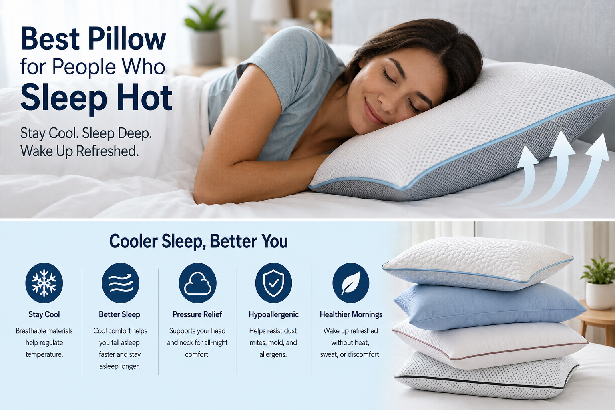
Frequently Asked Questions About the Best Pillow for People Who Sleep Hot
- What is the best pillow for people who sleep hot?
The best pillow for people who sleep hot is usually a breathable pillow made from materials such as latex, buckwheat, or a well-designed down alternative. Your sleeping position and personal comfort still matter.
- Is latex good for hot sleepers?
Yes. Latex can be an excellent choice because it is responsive and generally sleeps cooler than dense memory foam. Ventilated or shredded latex can provide even more airflow.
- Does memory foam make you hot?
It can. Traditional solid memory foam often holds more heat because it closely surrounds your head. However, ventilated foam, shredded foam, and cooling covers can reduce some of that heat.
- Are gel pillows actually cooling?
Gel pillows can help manage surface heat, but performance varies. A gel layer does not guarantee that the entire pillow will remain cool throughout the night.
- Is buckwheat good for hot sleepers?
Yes. Buckwheat hulls leave spaces that allow air to move through the pillow. However, buckwheat feels firmer and may make a gentle rustling sound.
- What pillow is best for sweaty sleepers?
Choose a pillow with a breathable, moisture-friendly cover. Cotton and Tencel covers can be useful options. Also, select a filling that does not trap excessive heat.
- Should hot sleepers use a soft pillow?
Not necessarily. Firmness should match your sleep position and support needs. Cooling and firmness are separate features.
- What is the best pillow for hot side sleepers?
A breathable higher-loft pillow can work well. Shredded latex is especially worth considering because it can provide support while allowing airflow.
- What is the best pillow for hot back sleepers?
A medium-loft breathable pillow often works well for back sleepers. Latex can provide responsive support without the deep sink of some memory foam.
- What is the best pillow for hot stomach sleepers?
A low, soft, breathable pillow is usually a better starting point. A very thick pillow can push your neck upward.
- Does the pillowcase affect sleeping temperature?
Yes. A thick synthetic pillowcase can reduce airflow and feel warmer. Lightweight breathable fabrics can improve the sleep surface.
- How can I make my current pillow cooler?
Start by using a breathable pillowcase. Then improve room airflow, reduce heavy bedding, and keep humidity under control. If the pillow itself remains hot, consider replacing it.
- Are expensive cooling pillows worth it?
They can be, but price does not guarantee better cooling. Look at the filling, cover, construction, support, warranty, and return policy instead.
- How often should I wash a pillowcase?
Wash it regularly, especially if you sweat heavily. A clean pillowcase can improve freshness and moisture control.
- Can a cooling pillow help with night sweats?
It may improve comfort by reducing heat around your head. However, frequent or unexplained night sweating can have many causes. If it concerns you, speak with a qualified health professional.
- Are cotton pillows good for hot sleepers?
Cotton covers can be breathable, but the filling also matters. A cotton cover around dense heat-retaining foam may not create the same cooling effect as a breathable fill.
- Is down good for hot sleepers?
Down can feel soft and luxurious, but it also provides insulation. Therefore, some hot sleepers may prefer latex, buckwheat, or breathable down alternatives.
- What pillow material has the best airflow?
Shredded latex and buckwheat are strong options because their structures leave room for air movement. However, the cover and overall pillow design also affect airflow.
- Can changing my pillow reduce overheating?
It can, especially if your current pillow traps heat around your head. However, room temperature, humidity, mattress materials, blankets, and sleepwear can also affect overheating.
- What should I look for in the best pillow for people who sleep hot?
Look for breathable filling, good airflow, a moisture-friendly cover, suitable loft, proper neck support, and a return policy. Most importantly, choose a pillow that fits your sleeping position.
Conclusion
Finding the best pillow for people who sleep hot does not have to be difficult.
Start with your sleep position.
Then consider the filling.
After that, look at the cover, airflow, loft, firmness, and cleaning requirements.
For many warm sleepers, latex is a strong place to start. Shredded latex can offer a useful mix of airflow, support, and adjustability. Buckwheat is another excellent option for people who want natural airflow and a firmer feel. Meanwhile, breathable down alternatives can provide a softer and cheaper choice.
Memory foam is not automatically off-limits. However, hot sleepers should look for ventilated, shredded, or specially designed cooling foam rather than assuming every gel or cooling label will work.
Most importantly, remember that your pillow is only one part of your sleep environment.
A cooler bedroom, lighter bedding, better airflow, and breathable sleepwear can all help. Sleep Foundation recommends keeping the bedroom comfortably cool and notes that bedding materials can affect temperature regulation.
So, if you regularly wake up hot, sweaty, or uncomfortable, start with the simplest change.
Try a breathable pillowcase.
If that does not help, upgrade the pillow.
Finally, choose based on airflow + support + sleep position + moisture control, rather than marketing words alone.
That approach will give you a much better chance of finding a pillow that stays comfortable from bedtime until morning.
External Sources
The article uses supporting information from Sleep Foundation’s cooling pillow research, including its testing of pillow materials and temperature control.
For general pillow selection, loft, firmness, and temperature control, see Sleep Foundation’s pillow shopping guide.
For bedroom temperature and cooling advice, see Sleep Foundation’s guide to sleep temperature