
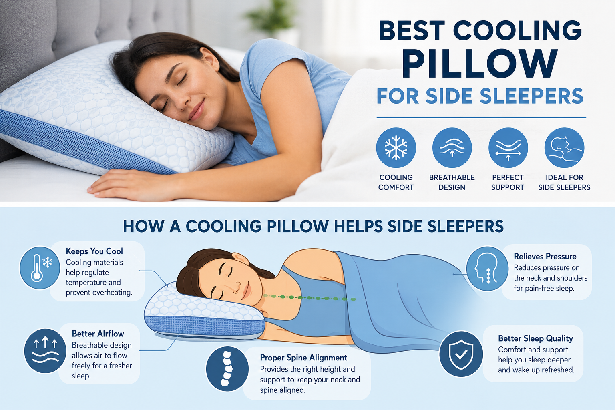
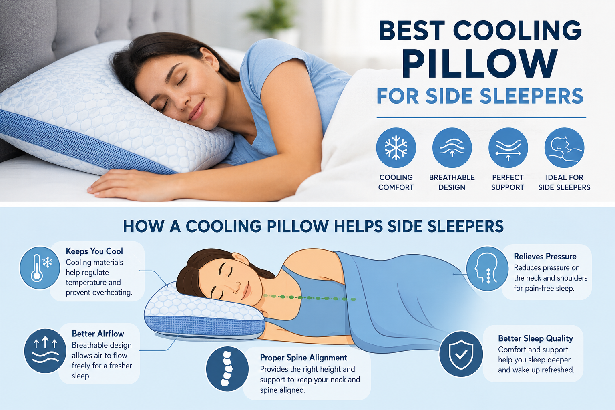
Best cooling pillow for side sleepers choices should do two jobs at once: keep your head and neck supported while helping you stay comfortable when you sleep hot. For side sleepers, that balance matters because your shoulder creates a larger gap between your head and mattress.
At the same time, a pillow that feels wonderfully soft may not give enough support. On the other hand, a very firm pillow can feel too stiff. Therefore, the right choice depends on your body shape, mattress, shoulder width, preferred pillow height, and how warm you get at night.
Current testing from Sleep Foundation shows that side sleepers often prefer thicker, supportive pillows, while adjustable loft can make it easier to find a good fit.
So, this guide explains what to look for, which materials work best, how much loft you may need, and how to avoid common buying mistakes.
Quick answer: If you want one strong starting point, look at a cooling pillow with medium-to-firm support, a higher loft, breathable materials, and an adjustable design. Among current expert-tested choices, the Helix GlacioTex Cooling Memory Foam Pillow — Side Sleeper stands out for cooling, pressure relief, and side-sleeping support. Sleep Foundation gave it an 8.1/10 testing score and found its 5.25-inch profile especially useful for side sleepers.
Why Side Sleepers Need a Different Pillow
Side sleeping changes the way your head sits on the bed.
When you lie on your side, your shoulder rests on the mattress. Your head, however, sits above that shoulder. Because of this, your pillow needs to fill the space between your head and the mattress.
If your pillow is too flat, your head can fall toward the mattress.
If it is too tall, your head can tilt upward.
Either way, your neck may spend hours in an awkward position.
Cleveland Clinic recommends keeping your head and neck aligned with the rest of your body while sleeping. It also notes that side sleepers generally need enough pillow thickness to prevent the head from bending sideways.
That is why a best cooling pillow for side sleepers needs more than a cool cover. It also needs the right height and support.
What Makes a Cooling Pillow Actually Cool?
Not every pillow labeled “cooling” works in the same way.
Some pillows feel cool when you first touch them. Others use materials designed to move heat away from your head. Some rely on airflow, while others use special cooling covers.
The main cooling features include:
- Breathable covers
- Ventilated foam
- Latex with open-air holes
- Phase-change materials
- Cooling fibers
- Gel layers
- Open-cell foam
- Moisture-wicking fabrics
- Mesh panels
- Natural fibers
However, cooling does not mean that a pillow stays ice-cold all night.
Instead, good temperature control usually means the pillow does not trap too much heat.
Sleep Foundation’s 2026 testing notes that cooling pillows can use breathable materials and special fabrics to reduce heat buildup and improve comfort for hot sleepers.
Best Cooling Pillow for Side Sleepers: Our Quick Picks
Choosing one pillow can feel confusing. So, here are several current options worth researching.
| Pillow | Best For | Main Strength | Possible Drawback |
| Helix GlacioTex Cooling Memory Foam Pillow – Side Sleeper | Hot side sleepers | Cooling and neck support | Foam may feel firm |
| Eli & Elm Cotton Side-Sleeper Pillow | Alignment | U-shaped side-sleeper design | Unique shape may take time to like |
| Helix ComfortAdjust Cooling Pillow | Combination sleepers | Adjustable loft | More adjustment than some people need |
| Saatva Latex Pillow | Natural feel | Breathable latex | Premium price |
| Nectar Tri-Comfort Cooling Pillow | Custom fit | Multiple loft settings | Foam requires careful cleaning |
| Brooklinen Marlow Pillow | Adjustable comfort | Adjustable firmness | Not fully machine washable |
Sleep Foundation currently lists the Eli & Elm Cotton Side-Sleeper Pillow among its top side-sleeper choices and names the Helix GlacioTex Side Sleeper as its best cooling pick for side sleepers.
Best Cooling Pillow for Side Sleepers: Helix GlacioTex
The Helix GlacioTex Cooling Memory Foam Pillow – Side Sleeper is one of the most interesting choices if cooling is your main goal.
Sleep Foundation reports that it comes in 4.75-inch and 5.25-inch profiles. The testing team found the thicker 5.25-inch version particularly well suited to side sleepers.
It uses solid memory foam, which gives your head and neck steady support.
At the same time, the GlacioTex cover helps manage heat.
The pillow also uses copper-infused foam, according to Sleep Foundation’s construction breakdown.
Who should consider it?
It may suit you if:
- You sleep mostly on your side.
- You often feel hot at night.
- You like memory foam.
- You want strong neck support.
- You prefer a pillow that keeps its shape.
However, stomach sleepers may find the taller profile too high.
Best Cooling Pillow for Side Sleepers: Eli & Elm
The Eli & Elm Cotton Side-Sleeper Pillow takes a different approach.
Instead of using a normal rectangle, it uses a U-shaped design.
That shape creates space for your shoulder while supporting your head and neck.
Sleep Foundation’s testers gave this pillow high marks from side sleepers. They also noted that the fill can be added or removed to change the loft.
The pillow uses shredded latex or shredded memory foam with polyester fiber, depending on the version.
Because you can adjust the fill, you do not have to accept one fixed height.
Why the shape matters
A normal pillow can push into your shoulder.
The U-shaped design creates a small opening for the shoulder.
Therefore, the pillow can feel more natural for people with broad shoulders or people who dislike a standard rectangular pillow.
Best Cooling Pillow for Side Sleepers: Saatva Latex
Latex deserves attention because it can offer both support and airflow.
Sleep Foundation currently lists the Saatva Latex Pillow as its overall top pillow and notes that its ventilated latex core allows air to circulate. The cover uses breathable Tencel.
The pillow comes in different lofts.
For side sleepers, the higher profile can be especially useful.
Latex also has a springy feel. Therefore, it does not usually give the deep sinking sensation that some memory foam pillows provide.
Good reasons to choose latex
- Strong support
- Good airflow
- Responsive feel
- Good shape recovery
- Less deep sinking
- Suitable for side and back sleepers
Still, latex is not perfect for everyone.
Some people prefer the slow, soft hug of memory foam. Others may also need to consider latex sensitivity.
Best Cooling Pillow for Side Sleepers: Helix ComfortAdjust
Combination sleepers often have a harder problem.
You may sleep on your side for part of the night and then move onto your back.
In that case, a fixed-height pillow may not feel right in every position.
The Helix ComfortAdjust Cooling Pillow lets you change the amount of fill and adjust the side zippers to change its loft. Sleep Foundation reports that side sleepers on its testing team often preferred near-maximum fill and full loft.
Therefore, this pillow can make sense if you want flexibility.
Best for
- Side and back sleepers
- People who change positions
- People unsure about pillow height
- Hot sleepers
- People who enjoy customizable pillows
The downside is simple: more adjustment means more decisions.
If you already know exactly what you like, you may not need all those options.
How High Should a Side-Sleeper Pillow Be?
There is no single perfect height for every person.
Your shoulder width matters.
Your mattress firmness matters too.
So does your body shape.
For example, a person with broad shoulders and a firm mattress may need a taller pillow than a smaller person sleeping on a soft mattress.
Cleveland Clinic explains that a firmer mattress can create a larger space between your head and mattress, while a softer mattress lets your shoulder sink farther into the bed.
Therefore, do not buy a pillow based only on a number printed on the box.
Instead, check your neck position.
The Simple Neck Alignment Test
Lie on your side in your normal sleep position.
Then ask someone to look at your head and neck from behind.
Your neck should look reasonably straight instead of bending toward the mattress or ceiling.
If your head drops down, the pillow may be too low.
If your head rises too high, the pillow may be too thick.
Cleveland Clinic’s pillow guidance recommends keeping your neck parallel to the mattress instead of bending it up or down.
This simple test can tell you more than a marketing label.
Why Shoulder Width Changes Everything
Your shoulder creates the main gap between your head and mattress.
A wider shoulder usually creates a larger gap.
A narrow shoulder usually creates a smaller gap.
Therefore, two people can use the same mattress and still need different pillows.
This is one reason adjustable pillows are useful.
You can add or remove fill until the pillow matches your body.
A pillow that feels too tall in a store may also feel different at home because your mattress changes how far your shoulder sinks.
Firm Mattress vs Soft Mattress
Your mattress and pillow work together.
On a firm mattress, your shoulder may not sink very far.
Therefore, you may need a taller pillow.
On a soft mattress, your shoulder may sink deeper.
As a result, you may need a lower pillow.
Cleveland Clinic specifically advises considering mattress firmness when choosing pillow thickness.
So, never choose a pillow without thinking about your mattress.
Memory Foam for Hot Side Sleepers
Memory foam can be excellent for support.
It molds around your head and neck.
However, traditional memory foam can sometimes feel warm.
That happens because dense foam can slow airflow.
Modern cooling foam pillows try to solve this problem with:
- Ventilation
- Gel
- Copper
- Graphite
- Open-cell structures
- Cooling covers
- Phase-change materials
For example, Sleep Foundation found the Helix GlacioTex pillow slept fairly cool compared with many other memory foam pillows tested.
Therefore, memory foam should not automatically be ruled out by hot sleepers.
Latex for Natural Cooling
Latex is another strong option.
It can provide support without the deep sink of memory foam.
Ventilated latex can also allow air to move through the pillow.
Sleep Foundation notes that the Saatva Latex Pillow uses ventilated Talalay latex and a breathable Tencel cover for temperature control.
Latex may be especially appealing if you want:
- Bounce
- Support
- Airflow
- Shape recovery
- Less sinking
However, the feel is different from memory foam.
Shredded Foam Gives You More Control
Shredded foam pillows can be useful because you can move or remove the fill.
This gives you more control over height.
It also lets you create a softer or firmer feel.
However, shredded foam may shift during the night.
You may also need to fluff it.
For side sleepers, that can be either a benefit or a problem.
If you enjoy changing your pillow shape, shredded foam may be great.
If you want a pillow that stays exactly the same, solid foam may work better.
Cooling Covers Are More Important Than They Look
The surface of your pillow touches your head for hours.
Therefore, the cover matters.
Common cover materials include:
- Cotton
- Tencel
- Polyester
- Bamboo-based fabrics
- Phase-change fabrics
- Mesh
- Blended fabrics
A breathable cover can help air move around the surface.
A moisture-wicking cover can also help if you sweat.
However, remember that a cool cover cannot completely fix a very hot pillow core.
What Is Phase-Change Cooling?
Phase-change material, often called PCM, is designed to absorb and release heat as temperature changes.
In simple terms, the material can help reduce sharp temperature changes at the surface.
This technology appears in some cooling bedding products.
However, you should not assume that every PCM pillow will feel dramatically cold all night.
Cooling performance depends on the full design.
The cover, foam, airflow, room temperature, and your own body heat all matter.
Gel Cooling: Helpful or Hype?
Gel is common in cooling pillows.
Some products place gel inside the foam.
Others use a gel layer near the surface.
Gel can help with initial cooling and heat management.
Still, gel does not magically make every pillow cold.
A pillow with poor airflow may still become warm.
Therefore, look at the whole construction instead of buying based on the word “gel” alone.
Best Cooling Pillow for Side Sleepers: What About Down?
Down feels soft and luxurious.
It can also feel breathable.
However, side sleepers often need more support than a very soft down pillow provides.
Sleep Foundation notes that down and down-alternative pillows can work for side sleepers, but side sleepers should make sure the pillow has enough loft and support.
So, if you love down, choose a firmer or higher-loft design.
Otherwise, your head may sink too low.
Down Alternative for Hot Sleepers
Down alternative pillows can feel soft without using animal down.
They often use polyester fibers.
Some are designed to improve airflow and reduce heat.
However, performance varies greatly between products.
A very fluffy polyester pillow may trap more heat than a breathable latex pillow.
Therefore, check the cover and internal structure too.
Buckwheat Pillows: A Different Cooling Choice
Buckwheat pillows use natural hulls.
Air can move through the small spaces between the hulls.
That can make them feel cooler than dense foam.
Cleveland Clinic notes that buckwheat pillows allow plenty of air circulation and can support the neck during side sleeping. However, the hulls can make noise when they move.
They also have a very different feel.
You may love them.
Or you may dislike the firm, grain-like texture.
Best Cooling Pillow for Side Sleepers With Neck Pain
If your pillow causes neck pain, cooling should not be your first concern.
Alignment comes first.
You want a pillow that keeps your head from falling down or rising too high.
Cleveland Clinic advises choosing a pillow that supports the head and keeps the neck aligned with the body.
Therefore, look for:
- Medium-firm support
- Correct loft
- Stable shape
- Good pressure relief
- Adjustable height
If pain continues despite changing your pillow, speak with a qualified health professional.
A pillow can improve comfort, but it cannot diagnose or treat every cause of neck pain.
Best Cooling Pillow for Side Sleepers With Shoulder Pain
Shoulder pain needs special care.
A very tall pillow can push your head upward.
A very flat pillow can let your head fall toward the mattress.
Both situations can feel uncomfortable.
A shoulder-friendly pillow should give your head enough height while leaving enough room for the shoulder.
U-shaped designs can help some people because the lower section creates space around the shoulder.
Sleep Foundation specifically highlights the shoulder-friendly shape of the Eli & Elm side-sleeper pillow.
The Pillow Should Not Push Your Shoulder Forward
This small detail often gets ignored.
When you lie on your side, your shoulder should remain comfortable.
If the pillow is too wide or badly shaped, it may push your shoulder forward.
That can create tension.
A pillow with a shoulder cutout or U-shaped lower edge may help.
However, not everyone needs a special shape.
Some people simply need the correct loft.
Best Cooling Pillow for Side Sleepers Who Sweat
If you sweat at night, look beyond the pillow.
Your bedroom temperature matters.
Your sheets matter.
Your blanket matters.
Your mattress can also hold heat.
Therefore, a cooling pillow works best as part of a cooler sleep setup.
Try lightweight bedding, breathable sheets, and good room airflow.
Also, wash your pillowcase often.
A sweaty pillowcase can feel warm and uncomfortable even when the pillow itself has good cooling features.
Breathability vs Cool-to-the-Touch Feel
These two things are not exactly the same.
A pillow can feel cool when you first touch it.
However, that does not guarantee strong airflow.
A breathable pillow may not feel icy at first.
Instead, it may simply resist heat buildup better over time.
For people who sleep hot, long-term temperature control can matter more than a dramatic cold feeling for the first few minutes.
How Pillow Loft Changes During Sleep
Some pillows compress when you place your head on them.
Others keep most of their height.
This matters for side sleepers.
A pillow that starts at six inches may compress to much less under your head.
Therefore, the listed height does not tell the whole story.
Firmness and fill density matter too.
Adjustable pillows help because you can make changes after sleeping on them for several nights.
Best Cooling Pillow for Side Sleepers Who Change Positions
If you move between side and back sleeping, choose flexibility.
An adjustable pillow can work well.
You can use more fill for side sleeping.
Then you can remove some fill if you spend more time on your back.
The Helix ComfortAdjust Cooling Pillow is designed around this idea, with adjustable fill and side zippers for loft changes.
Therefore, combination sleepers should strongly consider adjustable designs.
A Real-Life Example: The Broad-Shouldered Sleeper
Consider a fictional example.
James is tall and has broad shoulders. He sleeps on a firm mattress and usually sleeps on his right side.
His old pillow is soft and only about four inches high.
Every morning, James notices that his neck feels stiff.
He also wakes because his pillow feels warm.
Instead of buying another soft pillow, he chooses a higher-loft cooling pillow.
After testing the pillow for several nights, he finds that his head stays more level.
He also changes to lighter bedding.
The result is a more comfortable setup.
This example shows an important lesson: the best cooling pillow for side sleepers depends on both cooling needs and body alignment.
A Real-Life Example: The Small-Framed Sleeper
Now consider Mia.
Mia is smaller and has narrow shoulders.
She sleeps on a soft mattress.
A very tall side-sleeper pillow feels uncomfortable because her shoulder sinks deeply into the mattress.
So, she chooses an adjustable pillow and removes some fill.
This lets her lower the loft.
She also chooses a breathable pillowcase.
Again, the lesson is simple.
Do not copy someone else’s pillow height.
Your body and mattress change the answer.
Case Study: Why Adjustable Loft Can Win
Consider another fictional case study.
A couple buys the same cooling pillow model.
One person sleeps on a firm mattress.
The other sleeps on a softer mattress.
The first person keeps more fill.
The second person removes some fill.
Both people get a pillow that better fits their body.
This is the main advantage of adjustable designs.
One pillow can serve different needs.
Sleep Foundation’s current testing also highlights adjustable loft as useful for side sleepers and combination sleepers.
Case Study: When Cooling Was Not the Real Problem
Imagine a sleeper who wakes every morning with neck stiffness.
They assume the problem comes from sleeping hot.
So, they buy an expensive cooling pillow.
But the pillow is too flat.
The sleeper still wakes with neck discomfort.
The real issue was not cooling.
It was support.
This is why the best cooling pillow for side sleepers should always be judged by support first and cooling second.
Comfort needs both.
Expert Advice: Think About Alignment First
Cleveland Clinic’s guidance is clear: your pillow should support your head and help keep your neck aligned with the rest of your body.
That advice is simple enough to remember.
Your head should not tilt sharply up or down.
For side sleepers, a pillow that fills the shoulder-to-head gap is usually a better starting point.
Then, you can compare cooling features.
Expert Advice: Use a Pillow Between Your Knees
Your head pillow is not the only pillow that matters.
When you sleep on your side, your top leg can pull your hips forward.
A pillow between your knees can help keep your hips and spine in a more neutral position.
Cleveland Clinic recommends a pillow between the legs for side sleepers in several of its sleep-position guides.
Therefore, if you want better side-sleeping posture, consider a complete pillow setup.
Advantages of a Cooling Side-Sleeper Pillow
A good cooling pillow can offer several benefits.
Better temperature comfort
First, breathable materials can reduce the feeling of trapped heat.
Better neck support
Second, the correct loft can help maintain alignment.
Less pillow flipping
Third, a pillow that manages heat well may reduce the urge to search for the “cool side.”
Better pressure relief
Fourth, supportive foam or latex can spread pressure across a wider area.
More personal comfort
Finally, adjustable pillows allow you to change the height.
Together, these features can make bedtime more comfortable.
Disadvantages to Consider Before Buying
Cooling pillows also have downsides.
Higher price
Some advanced cooling pillows cost much more than basic pillows.
Different feel
Memory foam, latex, and specialty fabrics may feel unusual if you normally use fiberfill.
Off-gassing
Some foam pillows may have a temporary smell when first opened.
Cleaning limits
Some pillow cores cannot go into a washing machine.
Too much height
A high-loft pillow may work well for some side sleepers but feel uncomfortable for others.
Marketing claims
Not every “cooling” claim means the pillow will stay cold all night.
Therefore, always check the full construction and care instructions.
How to Choose the Best Cooling Pillow for Side Sleepers
Use this simple checklist.
Step 1: Check your sleep position
Are you a true side sleeper?
Or do you move onto your back?
Step 2: Check your shoulder width
Broad shoulders often need more loft.
Narrow shoulders may need less.
Step 3: Check your mattress
Firm mattress?
Consider more height.
Soft mattress?
You may need less.
Step 4: Decide how much support you want
Soft, medium, or firm?
Step 5: Pick your cooling technology
Look for breathable fabrics, ventilation, latex, phase-change materials, or other cooling features.
Step 6: Look for an adjustment option
If you are unsure about height, adjustable fill can save you from buying another pillow.
Cooling Materials Compared
| Material | Cooling | Support | Feel | Side Sleeper Fit |
| Latex | Excellent | High | Springy | Excellent |
| Memory foam | Medium to high | High | Contouring | Excellent |
| Shredded foam | Medium to high | Adjustable | Moldable | Excellent |
| Down | Good | Low to medium | Very soft | Depends on loft |
| Down alternative | Medium | Medium | Plush | Good |
| Buckwheat | Excellent airflow | High | Firm | Good |
| Polyester fiber | Varies | Low to medium | Fluffy | Depends on design |
The best material depends on your preferences.
For example, latex may suit someone who wants airflow and bounce.
Meanwhile, memory foam may suit someone who wants close pressure relief.
Solid Foam vs Shredded Foam
Solid foam gives a more stable shape.
It also tends to provide steady support.
Shredded foam offers more flexibility.
You can move the fill and change the loft.
However, shredded fill may need fluffing.
Therefore:
Choose solid foam if: you want stable support.
Choose shredded foam if: you want adjustability.
Both can work well.
Cooling Pillowcase Choices Matter Too
You do not have to replace your pillow immediately.
Sometimes, a better pillowcase can improve comfort.
Look for breathable materials such as cotton or Tencel.
Avoid very heavy, dense fabrics if you sleep hot.
Also, wash your pillowcase regularly.
A clean, breathable surface feels better and can reduce sweat buildup.
However, remember that a pillowcase cannot completely transform a heat-trapping pillow.
How to Test Your Pillow at Home
Do not judge a pillow after five minutes.
Instead, give your body time to adjust.
Try this simple test:
Night 1–2: Check your initial comfort.
Night 3–4: Notice your neck position.
Night 5–7: Look for morning stiffness and heat buildup.
Also, ask yourself:
- Did I wake up hot?
- Did my neck feel straight?
- Did my shoulder feel comfortable?
- Did the pillow lose height?
- Did I keep flipping it?
- Did I sleep through the night?
If the answer to most questions is yes, you may have found a good match.
Common Buying Mistakes to Avoid
Mistake 1: Buying only for cooling
Cooling cannot fix poor support.
Mistake 2: Choosing the tallest pillow
More height does not always mean more comfort.
Mistake 3: Ignoring your mattress
Your mattress changes the distance between your head and bed.
Mistake 4: Picking a pillow because it looks luxurious
Looks do not tell you how well it supports your neck.
Mistake 5: Ignoring return policies
A pillow can feel different after several nights.
Mistake 6: Forgetting pillow care
Some foam cores cannot be washed.
Mistake 7: Expecting an ice-cold pillow
Cooling usually means better temperature control, not permanent coldness.
Who Should Buy an Adjustable Pillow?
Adjustable pillows are especially useful if:
- You are unsure about your ideal loft.
- You switch between side and back sleeping.
- Your partner needs a different height.
- Your mattress is changing.
- You want to experiment.
- You often wake with neck discomfort.
The Helix ComfortAdjust and Eli & Elm designs are examples of pillows that let users change their setup.
When Should You Replace Your Pillow?
A pillow does not last forever.
Replace it when it:
- Stays flat
- Has permanent lumps
- No longer supports your head
- Smells despite cleaning
- Shows visible damage
- Causes new morning discomfort
- Has lost its original shape
Try folding a fiber pillow in half.
If it stays folded instead of returning to shape, it may be worn out.
For foam pillows, check whether the foam has permanent dents.
Best Cooling Pillow for Side Sleepers: Final Buying Checklist
Before you buy, ask these questions:
- Is it tall enough for my shoulder width?
- Is it too tall for my mattress?
- Does it support my neck?
- Does it stay cool?
- Is the cover breathable?
- Can I adjust the loft?
- Can I wash the cover?
- Does it have a trial period?
- Is the firmness right for me?
- Does the pillow keep its shape?
- Do I prefer latex or foam?
- Do I sleep hot enough to need advanced cooling?
- Do I change positions?
- Do I have a very soft mattress?
- Do I have a very firm mattress?
This checklist can make your decision much easier.
Best Cooling Pillow for Side Sleepers: Our Verdict
The best cooling pillow for side sleepers is not automatically the most expensive pillow.
Instead, look for the combination that fits your body.
For a hot side sleeper who wants firm, steady support, the Helix GlacioTex Cooling Memory Foam Pillow – Side Sleeper is a strong choice. Sleep Foundation’s 2026 testing found the 5.25-inch version particularly effective for side sleepers and rated its cooling and pressure relief highly.
For someone who wants a special side-sleeper shape, the Eli & Elm Cotton Side-Sleeper Pillow is worth considering. Its U-shaped design creates shoulder space, while its adjustable fill lets you change the height.
For people who prefer latex, the Saatva Latex Pillow offers a breathable, responsive design. Sleep Foundation reports strong temperature-control results from its ventilated latex core and breathable cover.
For combination sleepers, the Helix ComfortAdjust Cooling Pillow offers more control over loft and firmness.
Frequently Asked Questions
- What is the best cooling pillow for side sleepers?
The best cooling pillow for side sleepers should provide enough height to fill the gap between your head and shoulder while also allowing good airflow. Current expert testing gives strong consideration to the Helix GlacioTex Side Sleeper and Eli & Elm Cotton Side-Sleeper Pillow.
- Should side sleepers use a high pillow?
Usually, side sleepers need more loft than stomach sleepers because the shoulder creates a larger gap between the head and mattress. However, your mattress firmness and body size also matter.
- Is memory foam good for hot side sleepers?
Yes, modern memory foam pillows can work well for hot side sleepers when they include ventilation or cooling covers. However, traditional dense foam may feel warmer.
- Is latex cooler than memory foam?
Latex often allows strong airflow, especially when manufacturers ventilate the material. Sleep Foundation highlights ventilated latex as a temperature-control feature.
- What pillow height is best for side sleeping?
There is no universal height. Your shoulder width, body size, mattress softness, and pillow firmness all change the ideal height.
- Can a cooling pillow help neck pain?
A supportive pillow may improve comfort when poor alignment contributes to neck strain. However, ongoing or severe neck pain deserves professional evaluation.
- Is a soft pillow good for side sleepers?
A soft pillow can work if it has enough loft and does not collapse too much. However, many side sleepers need stronger support.
- Are cooling pillows worth the money?
They can be worth it if you regularly wake because of heat. However, a basic breathable pillow may be enough if you only feel slightly warm.
- Does gel make a pillow cooler?
Gel can help with temperature control, but the full pillow design matters. Airflow, cover material, foam density, and room temperature all affect results.
- What is the best pillow for side sleepers with broad shoulders?
Look for a higher-loft pillow or an adjustable pillow. A U-shaped or shoulder-friendly design may also provide useful space around the shoulder.
- Can I use a body pillow with a cooling head pillow?
Yes. A body pillow can support your legs and help you stay in a comfortable side position. Cleveland Clinic recommends strategic pillow support for side sleepers.
- Is an adjustable pillow better?
It can be better if you are unsure about your ideal loft. You can add or remove fill instead of replacing the entire pillow.
- How do I know if my pillow is too high?
Lie on your side and have someone check your head and neck from behind. If your head tilts upward, the pillow may be too tall.
- How do I know if my pillow is too low?
If your head drops toward the mattress, the pillow may not provide enough height.
- Can a pillow cause shoulder pain?
Yes, an unsuitable pillow can create an uncomfortable sleeping angle. However, shoulder pain can have many causes, so do not assume the pillow is always responsible.
- Should side sleepers put a pillow between their knees?
It can help. A pillow between the knees may help keep the hips and spine in a more neutral position.
- How often should I wash a pillowcase?
Wash your pillowcase regularly, especially if you sweat at night. Follow the fabric’s care instructions.
- Are cooling pillows safe?
Most commercial pillows are designed for normal sleep use. Follow the manufacturer’s care and use instructions, and stop using a product if it causes irritation or other problems.
- What is better for hot sleepers: latex or foam?
Both can work. Latex often offers strong airflow, while modern cooling foam can provide excellent contouring and pressure relief.
- What should I buy if I am still unsure?
Choose an adjustable pillow with a good trial or return policy. That gives you more room to test different heights and feels.
Conclusion
Finding the best cooling pillow for side sleepers becomes much easier when you stop looking at cooling as the only feature.
Start with alignment.
Then consider loft.
Next, think about firmness.
After that, look at cooling materials and breathability.
Finally, check the trial period and care instructions.
For many hot side sleepers, a medium-firm, higher-loft pillow with breathable construction offers a strong balance. The Helix GlacioTex Side Sleeper is a leading current option for cooling and support, while Eli & Elm offers a useful shoulder-friendly design.
Still, your perfect pillow may be different.
Your shoulder width, mattress, body size, and sleep habits all matter.
Therefore, use the information in this guide as a starting point rather than a strict rule.
The biggest goal is simple: keep your head and neck comfortable, keep your body aligned, and reduce unwanted heat.
When those three things work together, your pillow can become one of the easiest upgrades you make to your bedroom.
Recommended external resources
For additional research, readers can compare expert guidance from Sleep Foundation’s cooling pillow guide and its side-sleeper pillow testing guide. For neck and sleep-position guidance, Cleveland Clinic’s pillow and neck advice is also useful.
Editorial note: Product prices, availability, discounts, and policies can change. The product discussion above reflects sources available in August 2026 and should be checked on the manufacturer’s site before purchase.