
Best cooling pillow for hot sleepers depends on what makes you uncomfortable at night. If your main problem is heat, look for a pillow with good airflow, a breathable cover, and a fill that does not hold too much warmth.
For many people, shredded latex, ventilated latex, breathable fiber fills, and open designs can work well. Gel or cooling covers can also create a cool first touch. However, a cool-to-the-touch surface does not always stay cool all night.
Sleep Foundation’s 2026 testing explains that both the pillow’s fill and cover affect temperature control. Its testing also found that shredded latex, down alternative, and buckwheat can perform well for cooling, while solid memory foam tends to hold more heat.
Therefore, the right pillow should do three things:
- Keep heat from building up.
- Give your head and neck enough support.
- Let air and moisture move away from your skin.
This guide explains how to choose one without getting fooled by simple “ice-cold” marketing claims.
Why hot sleepers need a different pillow
Some people naturally feel warm during sleep. Others live in warm rooms, use thick bedding, or sleep on mattresses that hold heat.
Furthermore, your head rests on the pillow for hours. That means even a small amount of trapped heat can become annoying.
A pillow that feels fine for ten minutes may feel warm after several hours. Therefore, you should look beyond the first cool feeling.
A good cooling pillow should manage heat over time rather than simply feel cold when you first touch it.
What makes a pillow feel cool?
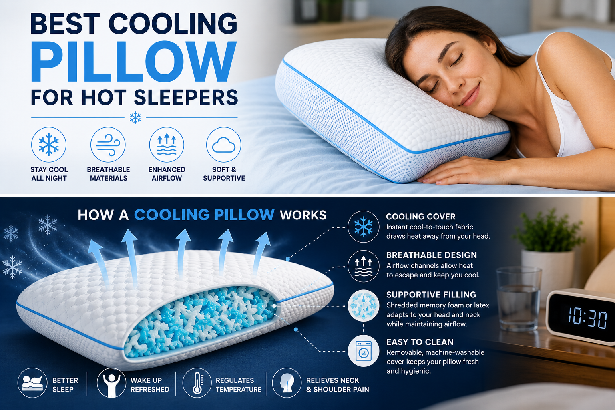
Cooling usually comes from several features working together.
First, the cover may use a breathable fabric. Cotton, bamboo-derived fabrics, and Tencel can allow better airflow and help manage moisture.
Second, the inner fill matters. A material with open space can allow air to move through the pillow.
Third, the pillow’s shape matters. A ventilated or open design can reduce heat buildup.
Finally, your pillowcase can make a major difference. Even an excellent pillow may feel warmer under a thick polyester case.
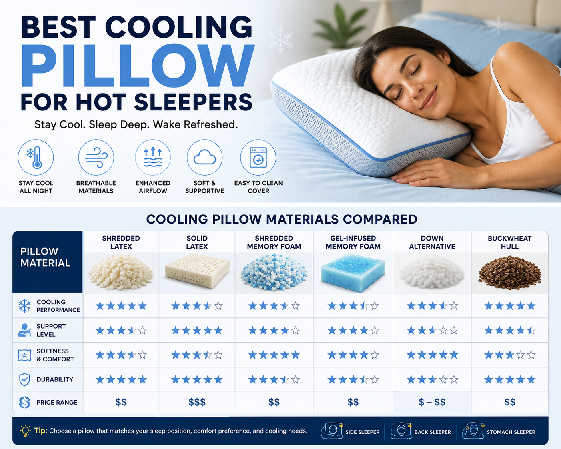
Best cooling pillow for hot sleepers by pillow material
There is no single material that wins for every person.
Instead, compare the major options.
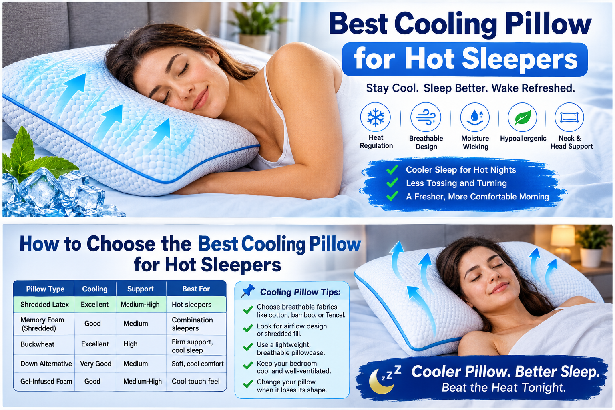
| Pillow material | Cooling potential | Support | Feel | Best for |
| Shredded latex | Excellent | Medium-high | Springy | Hot sleepers |
| Solid latex | Very good | High | Responsive | Side/back sleepers |
| Shredded memory foam | Good | Adjustable | Contouring | Combination sleepers |
| Solid memory foam | Fair | High | Deep contour | People who like firm support |
| Down alternative | Very good | Medium | Soft | People who want plush comfort |
| Buckwheat | Excellent airflow | High | Firm | People who like firm pillows |
| Gel-infused foam | Good | Medium-high | Contouring | People wanting cool-touch feel |
| Polyester fiber | Fair-good | Medium | Soft | Budget shoppers |
Sleep Foundation’s testing supports the idea that fill choice plays a major role in temperature control.
Why shredded latex can be a strong choice
Latex has a naturally springy feel.
Shredded latex also leaves spaces between pieces. Therefore, air can move through those spaces more easily than through some dense foam designs.
For a hot sleeper, that can be helpful.
Latex also responds quickly when you change position. So, combination sleepers may find it easier to move than on slow-response memory foam.
When memory foam is still worth considering
Memory foam gets a bad name among hot sleepers, but it is not always a poor choice.
Many people love memory foam because it supports the head and reduces pressure.
However, solid memory foam can hold more heat than some other pillow fills. Sleep Foundation specifically notes that solid memory foam tends to retain heat.
Therefore, if you love foam, consider:
- Shredded foam
- Ventilated foam
- Cooling covers
- Gel layers
- Adjustable designs
- Lower-density construction
These features may improve the experience.
Best cooling pillow for hot sleepers who love memory foam
If you want the feel of memory foam but dislike heat, do not automatically reject foam.
Instead, look for a design that separates cooling from support.
For example, a cooling cover can sit over a supportive foam core. A shredded design can also create more space for airflow.
The goal is not to make the foam magically cold. Rather, the goal is to reduce how quickly heat builds around your head.
Cooling gel: What does it really do?
Cooling gel is one of the most common features in bedding.
It can help absorb or move heat away from the surface. However, gel does not create endless cooling.
Think of it like a cold glass of water. The glass feels cool at first, but it eventually becomes closer to room temperature.
The same basic idea applies to many cooling surfaces.
Therefore, do not choose a pillow only because it says “gel cooling.”
Look at the whole design.
Cool-to-touch covers versus true airflow
A cool-touch cover can feel impressive when you first lie down.
However, there is a difference between surface cooling and long-term temperature control.
A cover may feel cold because it quickly pulls heat away from your skin. Yet, after the material warms, the effect may become less noticeable.
Airflow works differently.
An open pillow structure can help heat escape instead of simply absorbing it.
For hot sleepers, that difference matters.
Best cooling pillow for hot sleepers who sweat
Sweating creates another problem.
A pillow can feel warm because it traps both heat and moisture.
Therefore, choose a cover that can breathe and handle moisture.
Cotton is a popular choice. Bamboo-derived fabrics and Tencel are also commonly used in cooling bedding. Sleep Foundation recommends breathable and moisture-wicking materials for hot sleepers.
Also, check whether the cover can go into the washing machine.
That small feature can make daily life much easier.
Why the pillowcase matters more than you think
You could buy an expensive cooling pillow and then cover it with a thick, warm pillowcase.
That defeats part of the purpose.
Instead, try:
- Cotton percale
- Lightweight cotton
- Linen
- Breathable bamboo-derived fabric
- Tencel-based fabric
Avoid very thick cases if you already sleep hot.
Furthermore, wash your pillowcase often because sweat, skin oils, and moisture can build up.
Best cooling pillow for hot sleepers by sleep position
Your sleeping position should guide your pillow choice.
Side sleepers often need more height because their shoulder creates space between the mattress and head.
Back sleepers usually need a medium height.
Stomach sleepers often need a low, soft pillow.
Sleep Foundation similarly notes that side sleepers often prefer higher loft, while back sleepers commonly need medium loft and stomach sleepers generally prefer thinner pillows.
Therefore, cooling should never be your only buying factor.
A cold pillow that hurts your neck is still a bad pillow.
Side sleepers need height and airflow
Side sleepers put more pressure on one side of the pillow.
Therefore, the pillow needs enough height to keep the head from dropping toward the mattress.
At the same time, you do not want a huge, dense pillow that traps heat.
An adjustable shredded pillow can be useful because you can remove some filling.
This allows you to find the right balance between support and airflow.
Back sleepers need balanced support
Back sleepers usually need less height than side sleepers.
If the pillow is too tall, the head may tilt forward.
If it is too thin, the neck may lack support.
Therefore, medium-loft pillows often make sense for back sleepers.
A breathable fill can then add cooling without forcing you to sacrifice support.
Stomach sleepers need a low profile
Stomach sleeping can put the neck in an awkward position if the pillow is too tall.
Therefore, a thin pillow often works better.
A soft fiber pillow or low-profile adjustable pillow may be a good starting point.
Also, because your face sits close to the pillow, breathability becomes especially important.
Combination sleepers need flexibility
Combination sleepers move between positions.
For them, an adjustable pillow can be especially useful.
You may want more height while sleeping on your side and less height when sleeping on your back.
An adjustable pillow lets you change the fill.
Therefore, you do not have to buy a separate pillow for every position.
Best cooling pillow for hot sleepers with neck pain
Cooling should not come before support.
If you wake with neck pain, look for a pillow that keeps your head aligned with your spine.
A pillow with adjustable fill can help because you can change the height.
However, persistent or severe neck pain deserves professional medical advice rather than a pillow purchase alone.
A pillow can improve comfort, but it cannot diagnose or treat a medical condition.
How loft affects cooling
Loft means pillow height.
A very thick pillow contains more material around your head. Depending on its construction, that can reduce airflow.
However, a very thin pillow may not give enough support.
Therefore, choose the lowest height that still keeps your neck comfortable.
This simple approach can help both comfort and temperature control.
Firmness matters for hot sleepers
Firmness describes how much the pillow pushes back.
Soft pillows can feel comfortable but may flatten.
Firm pillows can provide stronger support but may feel too hard.
For many people, medium firmness offers a useful middle ground.
However, your sleeping position should guide the final choice.
Best cooling pillow for hot sleepers with broad shoulders
Broad-shouldered side sleepers usually need more loft.
Why?
Your shoulder creates more distance between your head and mattress.
Therefore, a thin pillow may let your head drop too far.
Look for:
- Higher loft
- Adjustable fill
- Strong edge support
- Breathable construction
- A washable cover
An adjustable pillow is particularly useful because you can fine-tune the height.
How pillow shape affects airflow
Shape can make a surprising difference.
A completely dense block gives heat fewer places to escape.
An open or shredded structure can create air pockets.
Some pillows also use channels, holes, grids, or special layers to improve airflow.
However, marketing terms vary between brands.
Therefore, focus on the actual construction instead of the name of the technology.
Best cooling pillow for hot sleepers and airflow
If airflow is your top priority, look for a design with open space.
Shredded latex is one example.
Buckwheat hulls are another.
Some open-grid designs also allow air to move around the head.
Sleep Foundation’s pillow research found strong temperature performance among some shredded latex, down alternative, and buckwheat designs.
What buckwheat pillows do differently
Buckwheat pillows use small hulls instead of foam.
The hulls create many tiny spaces.
As a result, air can move through the pillow.
They also provide a firmer, more structured feel.
However, some people dislike the rustling sound.
Therefore, buckwheat is not automatically right for everyone.
Down alternative can be surprisingly cool
Down alternative pillows can offer good airflow when they use breathable fibers and a light construction.
They also tend to feel soft and fluffy.
However, very dense synthetic fiber can still feel warm.
Therefore, check the fill density and cover.
Do not assume that every fiber pillow will sleep cool.
Best cooling pillow for hot sleepers on a budget
You do not need to spend hundreds of dollars.
Start with the basics.
Choose a breathable pillowcase, lightweight pillow, and adjustable fill if possible.
You can also improve your current pillow by replacing a heavy case with a breathable one.
Furthermore, use a fan to improve room airflow.
Sometimes the bedroom setup matters more than a premium pillow.
How room temperature changes pillow performance
Even the best pillow cannot completely overcome a very hot bedroom.
Your body releases heat during sleep.
Therefore, a warm room can make the entire bed feel uncomfortable.
Research has linked higher nighttime temperatures with shorter sleep duration.
So, use the pillow as one part of a larger cooling plan.
Best cooling pillow for hot sleepers in summer
Summer creates a simple challenge: more heat.
During hot months, combine your cooling pillow with:
- Lightweight sheets
- A breathable mattress protector
- A thin blanket
- A fan
- Better room ventilation
- Loose sleepwear
Also, avoid piling heavy blankets around your head.
The goal is to let heat escape.
How to wash and maintain a cooling pillow
Maintenance matters.
First, check the care label.
Some pillows allow machine washing.
Others only allow cover washing and spot cleaning.
Do not put foam in a washing machine unless the manufacturer clearly says it is safe.
Also, dry washable covers completely before using them.
Moisture trapped inside bedding can create odors and encourage unwanted growth.
How often should you replace a pillow?
There is no universal replacement date.
Instead, inspect the pillow.
Replace it when it:
- Loses its shape
- Develops permanent lumps
- Stops supporting your neck
- Has a strong lasting odor
- Becomes difficult to clean
- Shows serious wear
A good pillow should continue to provide useful support.
Best cooling pillow for hot sleepers: Real-life example
Imagine a person who sleeps mostly on their side.
They use a dense memory foam pillow with a thick polyester case.
Every night, the pillow feels cool for a few minutes. Then it becomes warm.
They decide to buy another “ice cooling” pillow.
However, they make the same mistake again.
Instead, they could switch to an adjustable pillow with a breathable cover and more open fill.
They could also replace the thick case with lightweight cotton.
The lesson is simple: do not focus on the word cooling alone.
Look at the entire sleep system.
Case study: The pillow was not the only problem
Consider another example.
A sleeper complains that every pillow feels hot.
They buy three different cooling pillows.
None solves the problem.
Eventually, they notice that the mattress protector is waterproof and thick. Their sheets are also heavy. The bedroom has little airflow.
They change the bedding and improve ventilation.
Suddenly, their current pillow feels much more comfortable.
This example shows why cooling needs a whole-bed approach.
Expert advice for choosing a cooling pillow
Sleep Foundation’s experts emphasize that materials, temperature control, firmness, loft, and sleeping position all matter.
A useful rule is:
Choose support first, then improve cooling without ruining that support.
If a pillow keeps you cool but leaves your neck uncomfortable, it is not the right choice.
Likewise, a perfectly supportive pillow that makes you sweat all night may also be a poor match.
You need both.
Advantages of a cooling pillow
A well-designed cooling pillow can offer several benefits.
Better nighttime comfort
Less heat around your head can make bedtime more pleasant.
Better moisture management
Breathable fabrics can help deal with sweat.
More airflow
Open designs can reduce heat buildup.
Better support
Many cooling pillows also offer adjustable or supportive designs.
More choice
Today, hot sleepers can choose from latex, fiber, foam, buckwheat, gel, and other constructions.
Disadvantages of cooling pillows
Cooling pillows also have limits.
They may not stay cold
A cool surface can warm up.
Some cost more
Advanced materials can increase the price.
Some make noise
Buckwheat hulls may rustle when you move.
Some need special care
Foam pillows may require spot cleaning.
Some feel different
Latex can feel springier than memory foam.
Therefore, read the product’s care instructions before buying.
Best cooling pillow for hot sleepers: What to avoid
Be careful with vague claims.
Words such as “arctic,” “ice,” “zero heat,” and “freezing” sound impressive.
However, they do not tell you how the pillow works.
Instead, look for specific details:
- Cover material
- Fill material
- Airflow design
- Loft
- Firmness
- Washability
- Trial period
- Warranty
Specific information is more useful than dramatic marketing.
How to compare cooling pillow brands
Do not compare only prices.
Create a simple checklist.
Ask:
- What is inside?
- What covers it?
- Can I adjust the height?
- Can I wash the cover?
- Does it allow airflow?
- What is the return period?
- What warranty is offered?
- Is the material certified when certification matters?
For foam products, CertiPUR-US says its certification covers physical performance, chemical analysis, and emissions criteria for certified foam.
Why certifications can matter
Certifications do not automatically mean a pillow is comfortable.
However, they can provide useful information about materials and manufacturing standards.
If a pillow uses foam, check whether the exact foam is certified rather than simply assuming the whole product has certification.
CertiPUR-US also warns consumers to verify certification through its participating-company directory.
That is a helpful habit when shopping.
How to test your pillow at home
Give yourself several nights.
The first night may feel strange because your body is adjusting.
Check four things:
Temperature: Did you wake because of heat?
Support: Did your neck feel comfortable?
Position: Did you stay aligned?
Moisture: Did the pillow or case feel damp?
Write down what you notice.
After several nights, the pattern becomes clearer.
A simple cooling pillow scorecard
Use this 10-point system:
| Feature | Score |
| Airflow | /10 |
| Breathable cover | /10 |
| Moisture control | /10 |
| Neck support | /10 |
| Loft | /10 |
| Firmness | /10 |
| Washability | /10 |
| Adjustability | /10 |
| Durability | /10 |
| Price value | /10 |
Add the scores.
Then compare two or three pillows.
This method keeps you from choosing based only on advertising.
Best cooling pillow for hot sleepers: A practical buying checklist
Before purchasing, ask these questions:
- Do I sleep on my side, back, stomach, or all three?
- Do I sweat at night?
- Do I like soft or firm pillows?
- Do I need adjustable height?
- Do I prefer foam or fiber?
- Do I need a washable cover?
- Is airflow more important than a cold first touch?
- What is my budget?
- Can I return the pillow if it does not work?
These questions can narrow your choices quickly.
Should you choose an adjustable pillow?
For many shoppers, adjustability is one of the most useful features.
You can remove filling if the pillow feels too high.
You can add filling if it feels too low.
That flexibility becomes especially useful for combination sleepers.
Current Sleep Foundation testing also highlights adjustable cooling pillows as useful for sleepers with changing support needs.
Best cooling pillow for hot sleepers: Current expert-tested example
As of 2026, Sleep Foundation lists the Helix ComfortAdjust Cooling Pillow as its “Best Cooling” pillow in its current testing guide. The pillow uses shredded memory foam and down-alternative fibers, along with a GlacioTex cooling cover.
That does not mean it will be the best choice for every person.
For example, a stomach sleeper may want less height. A person who dislikes foam may prefer latex or fiber.
So, use expert picks as a starting point rather than a final answer.
Best cooling pillow for hot sleepers: Who should buy one?
A cooling pillow may be especially useful if you:
- Wake with a sweaty head
- Flip your pillow repeatedly
- Sleep in a warm bedroom
- Dislike dense foam
- Want a breathable pillow
- Live in a hot climate
- Wake because your pillow feels warm
- Prefer cool bedding
However, if your bedroom is already cool and you rarely feel warm, standard breathable bedding may be enough.
When a cooling pillow may not solve the problem
Sometimes overheating has little to do with the pillow.
Your mattress, comforter, room temperature, clothing, humidity, or other factors can all matter.
Therefore, do not keep buying pillows if the whole room remains too warm.
Start by checking the complete sleep setup.
Also, if night sweating is new, severe, or unexplained, consider speaking with a healthcare professional.
A pillow should not be used to explain a new health problem.
Best cooling pillow for hot sleepers: Final buying recommendation
For most hot sleepers, I would start with a breathable, adjustable pillow that combines good airflow with enough neck support.
If you prefer a springy feel, consider latex.
If you love contouring, consider shredded memory foam with a cooling cover.
If you prefer soft comfort, look at breathable down-alternative fiber.
If you want strong airflow and a firm feel, consider buckwheat.
If you mainly want a cold first touch, a gel or specialty cooling cover may appeal to you.
Most importantly, match the pillow to your sleep position.
Frequently Asked Questions
- What is the best cooling pillow for hot sleepers?
The best cooling pillow for hot sleepers is one that combines airflow, breathable materials, moisture control, and proper neck support. Shredded latex, breathable fiber, and some adjustable designs can be strong choices.
- Do cooling pillows really work?
Yes, cooling pillows can reduce heat buildup. However, most do not stay literally cold all night. Their main job is to manage heat and moisture better than a warm, dense pillow.
- Is memory foam good for hot sleepers?
Memory foam can work for hot sleepers, but solid memory foam may hold more heat. Look for shredded or ventilated foam and a breathable cooling cover.
- Is latex cooler than memory foam?
Latex often has an advantage for airflow, especially when it has an open or ventilated structure. However, the exact design still matters.
- What pillow material stays coolest?
There is no single winner for everyone. Shredded latex, some down-alternative fills, and buckwheat can offer good airflow. Sleep Foundation’s research supports these materials as strong options for temperature control.
- Are gel pillows actually cooling?
Gel can provide a cooler surface and may help move heat away from the skin. However, the effect can fade after the material warms.
- What is the coolest pillow for side sleepers?
A breathable, medium-to-high loft pillow can work well for side sleepers. Adjustable fill is useful because you can change the height.
- What is the best pillow for sweaty sleepers?
Look for breathable fabric, moisture management, airflow, and easy washing. A lightweight cotton, bamboo-derived, or Tencel cover can be helpful.
- Should hot sleepers use a thin pillow?
Not always. Your pillow still needs to support your sleeping position. Side sleepers often need more height, while stomach sleepers usually prefer less height.
- Are bamboo pillows good for hot sleepers?
Bamboo-derived fabrics can be breathable and useful for temperature management. However, check the entire pillow design because the cover alone does not determine cooling.
- Is a cooling pillow worth the money?
It can be worth it if heat regularly disrupts your sleep. However, you can often improve cooling with a breathable pillowcase and better bedroom airflow before spending a lot.
- Why does my cooling pillow get hot?
The pillow eventually absorbs heat from your head. If the material has limited airflow, heat can build up faster. A breathable construction can help.
- Can a pillowcase make a pillow hotter?
Yes. Thick or poorly breathable fabric can reduce airflow and make the pillow feel warmer.
- How do I keep my pillow cool all night?
Use a breathable pillowcase, keep the bedroom comfortable, improve airflow, avoid heavy bedding, and choose an open pillow construction.
- Is shredded foam cooler than solid foam?
Often, yes. Shredded foam can leave more spaces for air movement. Sleep Foundation notes that solid foam tends to retain more heat than some open fills.
- Are cooling pillows good for summer?
Yes. They can be particularly useful during hot weather. Still, room temperature and bedding also have a large effect.
- Can hot sleepers use down pillows?
They can, but down naturally provides insulation. If you sleep very hot, breathable alternatives may be more suitable.
- How high should a cooling pillow be?
The correct height depends on your position and body shape. Side sleepers generally need more height, back sleepers usually need medium height, and stomach sleepers often need a low pillow.
- Should I buy an expensive cooling pillow?
Not necessarily. Price does not guarantee better cooling. Look at materials, construction, adjustability, warranty, trial period, and real user needs.
- What is the most important feature in a cooling pillow?
For long-term cooling, airflow and breathable materials are among the most important features. However, proper support should remain a top priority.
Conclusion
Finding the best cooling pillow for hot sleepers does not mean finding the pillow with the coldest name or the most dramatic advertisement.
Instead, focus on how the pillow manages heat over several hours.
Look for breathable covers. Choose materials that allow airflow. Consider shredded latex, breathable fiber, buckwheat, or ventilated foam based on your preferred feel. Also, remember that a pillow must support your head and neck correctly.
Most importantly, do not judge a pillow only by its first five minutes.
A surface can feel cold when you first touch it and still become warm later. Long-term comfort depends on the complete design.
Your pillowcase, mattress, sheets, blanket, room temperature, and airflow also matter. Therefore, build a cooling sleep setup instead of expecting one product to fix everything.
For shoppers who want an expert-tested starting point, Sleep Foundation’s current 2026 guide names the Helix ComfortAdjust Cooling Pillow as its best cooling pick, while its broader research points to shredded latex, down alternative, and buckwheat as materials worth considering for temperature control.
Finally, choose based on your sleeping position, body shape, preferred firmness, budget, and heat problem. The right pillow should help you feel supported and comfortable, not simply cold.
Helpful external resources
- Sleep Foundation — Best Cooling Pillows of 2026
- Sleep Foundation — Pillow Research Methodology
- Sleep Foundation — How to Shop for Pillows
- CertiPUR-US — Certified Foam Information